
|
You entered: dust
 Rigel and the Witch Head Nebula
31.10.2024
By starlight, this eerie visage shines in the dark with a crooked profile evoking its popular name, the Witch Head Nebula. In fact, this entrancing telescopic portrait gives the impression that a witch has fixed her gaze on Orion's bright supergiant star Rigel.
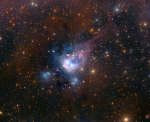 Young Suns of NGC 7129
29.08.2016
Young suns still lie within dusty NGC 7129, some 3,000 light-years away toward the royal constellation Cepheus. While these stars are at a relatively tender age, only a few million years old, it is likely that our own Sun formed in a similar stellar nursery some five billion years ago.
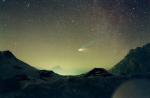 Comet Hale-Bopp Over Val Parola Pass
17.03.1997
Comet Hale-Bopp is now much brighter than any surrounding stars. It can be seen even over bright city lights. Out away from city lights, however, it is putting on quite a spectacular show. Here Comet Hale-Bopp was photographed last week above Val Parola Pass in the Dolomite mountains surrounding Cortina d'Ampezzo, Italy.
 Spiral Galaxy NGC 1232
25.01.2004
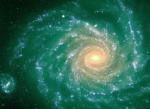
Galaxies are fascinating not only for what is visible, but for what is invisible. Grand spiral galaxy NGC 1232, captured in detail by one of the new Very Large Telescopes, is a good example.
 Massive Stars Of 30 Doradus
30.09.1999
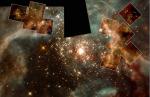
This gorgeous visible-light Hubble Space Telescope image shows a young cluster of massive stars at the center of the 30 Doradus Nebula. Gas and dust clouds in 30 Doradus, also known as the Tarantula Nebula, have been sculpted into elongated shapes by powerful winds and ultraviolet radiation from these hot cluster stars.
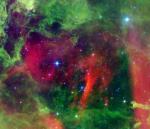 Hot Stars in the Rosette Nebula
26.07.2007
Winds and radiation from massive hot stars in the Rosette Nebula have cleared the natal gas and dust from the center of the nearby star-forming region. They also pose a danger to planet forming disks around young, cooler stars in the neighborhood.
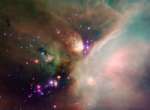 Young Stars in the Rho Ophiuchi Cloud
13.11.2009
Cosmic dust clouds and embedded newborn stars glow at infrared wavelengths in this tantalizing false-color view from the Spitzer Space Telescope. Pictured is of one of the closest star forming regions, part of the Rho Ophiuchi cloud complex some 400 light-years distant near the southern edge of the pronounceable constellation Ophiuchus.
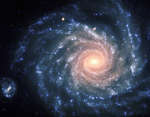 Grand Spiral Galaxy NGC 1232
7.01.2012
Galaxies are fascinating not only for what is visible, but for what is invisible. Grand spiral galaxy NGC 1232, captured in detail by one of the new Very Large Telescopes, is a good example.
 Comet Hale Bopp Over Val Parola Pass
23.12.2012
Comet Hale-Bopp, the Great Comet of 1997, became much brighter than any surrounding stars. It was seen even over bright city lights. Away from city lights, however, it put on quite a spectacular show. Here Comet Hale-Bopp was photographed above Val Parola Pass in the Dolomite mountains surrounding Cortina d'Ampezzo, Italy.
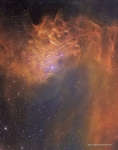 IC 405: The Flaming Star Nebula
7.01.2020
Rippling dust and gas lanes give the Flaming Star Nebula its name. The orange and purple colors of the nebula are present in different regions and are created by different processes. The bright star...
|
January February March April May June July August September October |
|||||||||||||||||||||||||||||||||||||||||||||||||