
|
You entered: dust
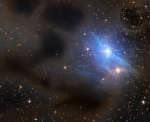 Reflections on vdB 31
11.03.2017
Riding high in the constellation of Auriga, beautiful, blue vdB 31 is the 31st object in Sidney van den Bergh's 1966 catalog of reflection nebulae. It shares this well-composed celestial still life with dark, obscuring clouds recorded in Edward E. Barnard's 1919 catalog of dark markings in the sky.
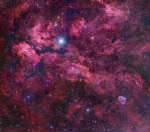 Central Cygnus Skyscape
22.03.2017
In cosmic brush strokes of glowing hydrogen gas, this beautiful skyscape unfolds across the plane of our Milky Way Galaxy near the northern end of the Great Rift and the center of the constellation Cygnus the Swan. A 36 panel mosaic of telescopic image data, the scene spans about six degrees.
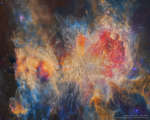 The Orion Nebula in Infrared from WISE
2.01.2019
The Great Nebula in Orion is an intriguing place. Visible to the unaided eye, it appears as a small fuzzy patch in the constellation of Orion. But this image, an illusory-color four-panel mosaic taken...
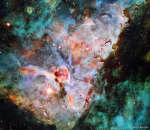 Clouds of the Carina Nebula
2.05.2021
What forms lurk in the mists of the Carina Nebula? The dark ominous figures are actually molecular clouds, knots of molecular gas and dust so thick they have become opaque. In comparison, however, these clouds are typically much less dense than Earth's atmosphere.
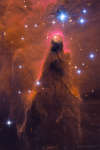 APOD: 2023 January 10 Б NGC 2264: The Cone Nebula
10.01.2023
Stars are forming in the gigantic dust pillar called the Cone Nebula. Cones, pillars, and majestic flowing shapes abound in stellar nurseries where clouds of gas and dust are sculpted by energetic winds from newborn stars. The Cone Nebula, a well-known example, lies within the bright galactic star-forming region NGC 2264.
 APOD: 2024 November 6 Б Comet Tsuchinshan Atlas over the Dolomites
6.11.2024
Comet Tsuchinshan-Atlas is now headed back to the outer Solar System. The massive dusty snowball put on quite a show during its trip near the Sun, resulting in many impressive pictures from planet Earth during October. The featured image was taken in mid-October and shows a defining visual feature of the comet -- its impressive anti-tail.
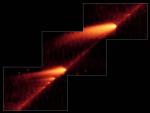 Crumbling Comet
13.05.2006
This false-color mosaic of crumbling comet Schwassmann-Wachmann 3 spans about 6 degrees (12 full moons) along the comet's orbit. Recorded on May 4-6 by an infrared camera on board the Spitzer Space Telescope, the picture captures about 45 of the 60 or more alphabetically cataloged large comet fragments.
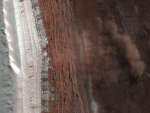 An Avalanche on Mars
11.03.2008
What caused this sudden cloud of dust on Mars? An avalanche! The first avalanche imaged in progress on another planet was recorded last month on Mars by NASA's robotic Mars Reconnaissance Orbiter. Visible...
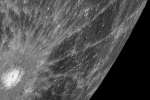 A Spectacular Rayed Crater on Mercury
3.11.2008
Why does Mercury have so many rayed craters? No one is sure. The robotic MESSENGER spacecraft that is taking unprecedented images as it swoops past the innermost planet has provided dramatic confirmation that Mercury has more rayed craters than Earth's Moon.
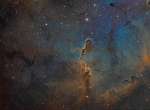 The Elephant s Trunk in IC 1396
26.07.2013
Like an illustration in a galactic Just So Story, the Elephant's Trunk Nebula winds through the emission nebula and young star cluster complex IC 1396, in the high and far off constellation of Cepheus. Of course, the cosmic elephant's trunk is over 20 light-years long.
|
January February March April May June July August September October |
|||||||||||||||||||||||||||||||||||||||||||||||||