
|
You entered: dust
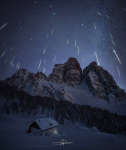 Gemini s Meteors
17.12.2020
Taken over the course of an hour shortly after local midnight on December 13, 35 exposures were used to create this postcard from Earth. The composited night scene spans dark skies above the snowy Italian Dolomites during our fair planet's annual Geminid meteor shower.
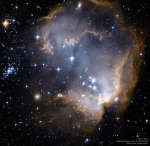 NGC 602 and Beyond
16.05.2021
The clouds may look like an oyster, and the stars like pearls, but look beyond. Near the outskirts of the Small Magellanic Cloud, a satellite galaxy some 200 thousand light-years distant, lies 5 million year young star cluster NGC 602.
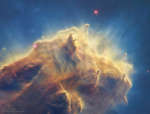 Star Formation in the Eagle Nebula
14.03.2022
Where do stars form? One place, star forming regions known as "EGGs", are being uncovered at the end of this giant pillar of gas and dust in the Eagle Nebula (M16). Short for evaporating gaseous globules, EGGs are dense regions of mostly molecular hydrogen gas that fragment and gravitationally collapse to form stars.
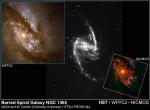 NGC 1365: Barred Spiral Galaxy
8.10.1999
NGC 1365 is a giant barred spiral galaxy about 200,000 light-years in diameter and 60 million light-years distant in the southern constellation Fornax. These three recently released images offer views of this majestic island universe in visible and infrared light.
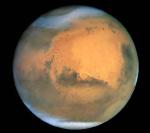 Mars from Earth
18.07.2001
Last month, Mars and Earth were right next to each other in their orbits. Formally called opposition, the event was highlighted by a very bright Mars for skywatchers and a good photo opportunity for the Hubble Space Telescope. Above, Hubble snapped the highest resolution picture of Mars ever obtained from the Earth.
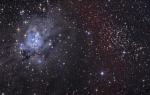 NGC 7129 and NGC 7142
13.09.2007
This alluring telescopic image looks toward the constellation Cepheus and an intriguing visual pairing of dusty reflection nebula NGC 7129 (left) and open star cluster NGC 7142. The two appear separated by only half a degree on the sky, but they actually lie at quite different distances.
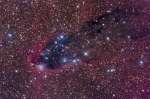 The Dark Tower in Scorpius
8.05.2008
In silhouette against a crowded star field toward the constellation Scorpius, this dusty cosmic cloud evokes for some the image of an ominous dark tower. In fact, clumps of dust and molecular gas collapsing...
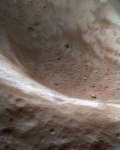 The Regolith of Asteroid Eros
19.06.2011
From fifty kilometers above asteroid Eros, the surface inside one of its largest craters appears covered with an unusual substance: regolith. The thickness and composition of the surface dust that is regolith remains a topic of much research.
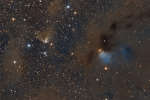 Dusty Nebulae in Taurus
11.07.2013
This complex of dusty nebulae linger along the edge of the Taurus molecular cloud, a mere 450 light-years distant. Stars are forming on the cosmic scene, including extremely youthful star RY Tauri prominent toward the upper left of the 1.5 degree wide telescopic field.
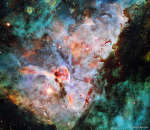 Clouds of the Carina Nebula
16.05.2016
What forms lurk in the mists of the Carina Nebula? The dark ominous figures are actually molecular clouds, knots of molecular gas and dust so thick they have become opaque. In comparison, however, these clouds are typically much less dense than Earth's atmosphere.
|
January February March April May June July August September October |
|||||||||||||||||||||||||||||||||||||||||||||||||