
|
You entered: dust
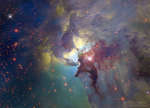 The Lively Center of the Lagoon Nebula
25.05.2022
The center of the Lagoon Nebula is a whirlwind of spectacular star formation. Visible near the image center, at least two long funnel-shaped clouds, each roughly half a light-year long, have been formed by extreme stellar winds and intense energetic starlight. A tremendously bright nearby star, Herschel 36, lights the area.
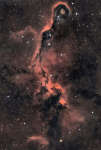 APOD: 2026 August 20 Б The Elephant s Trunk in Cepheus
20.08.2026
Like an illustration in a galactic Just So Story, the Elephant's Trunk Nebula winds through the emission region and young star cluster complex IC 1396, in the high and far off constellation of Cepheus. Also known as vdB 142, this cosmic elephant's trunk is over 20 light-years long.
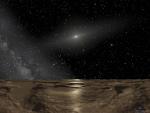 Sedna at Noon
4.06.2004
Standing on Sedna - the solar system's most distant known planetoid - your view of the Sun at high noon might look something like this. An artist's dramatic vision, the picture shows the Sun suspended above the nearby horizon as a bright star immersed in the dusty ecliptic plane.
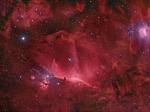 Wisps Surrounding the Horsehead Nebula
21.02.2006
The famous Horsehead Nebula in Orion is not alone. A deep exposure shows that the dark familiar shaped indentation, visible just below center, is part of a vast complex of absorbing dust and glowing gas.
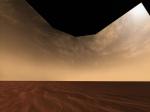 Clouds and Sand on the Horizon of Mars
17.10.2006
If you could stand on Mars -- what might you see? Like the robotic Opportunity rover rolling across the red planet, you might well see vast plains of red sand, an orange tinted sky, and wispy light clouds.
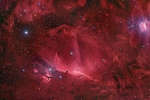 Wisps Surrounding the Horsehead Nebula
6.04.2008
The famous Horsehead Nebula in Orion is not alone. A deep exposure shows that the dark familiar shaped indentation, visible just below center, is part of a vast complex of absorbing dust and glowing gas.
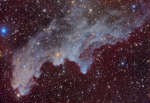 IC 2118: The Witch Head Nebula
17.01.2012
Double, double toil and trouble; Fire burn, and cauldron bubble -- maybe Macbeth should have consulted the Witch Head Nebula. This suggestively shaped reflection nebula is associated with the bright star Rigel in the constellation Orion.
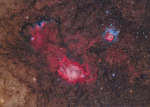 A Sagittarius Triplet
30.08.2013
These three bright nebulae are often featured in telescopic tours of the constellation Sagittarius and the crowded starfields of the central Milky Way. In fact, 18th century cosmic tourist Charles Messier cataloged two of them; M8, the large nebula left of center, and colorful M20 on the right.
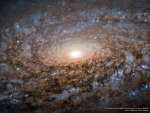 In the Center of Spiral Galaxy NGC 3521
30.11.2015
This huge swirling mass of stars, gas, and dust occurs near the center of a nearby spiral galaxy. Gorgeous spiral NGC 3521 is a mere 35 million light-years distant, toward the constellation Leo. Spanning some 50,000 light-years, its central region is shown in this dramatic image, constructed from data from the Hubble Space Telescope.
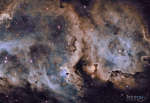 W5: The Soul of Star Formation
29.11.2016
Where do stars form? Many times, stars form in energetic regions where gas and dark dust are pushed around in chaotic mayhem. Pictured, bright massive stars near the center of W5, the Soul Nebula, are exploding and emitting ionizing light and energetic winds.
|
January February March April May June July August September October |
|||||||||||||||||||||||||||||||||||||||||||||||||