
|
You entered: planet
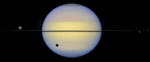 Saturn's Rings Seen Sideways
29.04.1996
Saturn's rings are actually very thin. This picture from the Hubble Space Telescope was taken on August 6, 1995 when the rings lined up sideways as seen from Earth. Saturn's largest moon Titan is seen on the left, and Titan's shadow can be seen on Saturn's cloud tops!
 Neptune in Infrared
25.10.1999
Neptune has never looked so clear in infrared light. Neptune is the eighth most distant planet from the Sun, thirty times the Earth-Sun distance. Neptune is the fourth largest planet, almost four times Earth's diameter. Surprisingly, Neptune radiates about twice as much energy as it receives from the Sun.
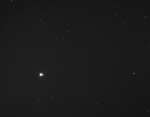 Earth and Moon from MESSENGER
1.09.2010
What does Earth look like from the planet Mercury? The robotic spacecraft MESSENGER found out as it looked toward the Earth during its closest approach to the Sun about three months ago. The Earth and Moon are visible as the double spot on the lower left of the above image.
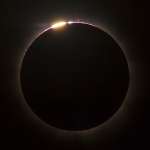 Solar Eclipse over Queensland
15.11.2012
This month's New Moon brought a total solar eclipse to parts of planet Earth on November 13 (UT). Most of the total eclipse track fell across the southern Pacific, but the Moon's dark umbral shadow began its journey in northern Australia on Wednesday morning, local time.
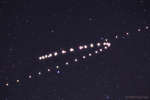 Retrograde Mars
27.10.2014
Why would Mars appear to move backwards? Most of the time, the apparent motion of Mars in Earth's sky is in one direction, slow but steady in front of the far distant stars. About every two years, however, the Earth passes Mars as they orbit around the Sun.
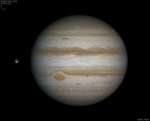 Jupiter, Ganymede, Great Red Spot
15.05.2015
In this sharp snapshot, the Solar System's largest moon Ganymede poses next to Jupiter, the largest planet. Captured on March 10 with a small telescope from our fair planet Earth, the scene also includes Jupiter's Great Red Spot, the Solar System's largest storm.
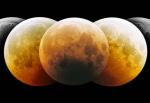 Eclipsed Moon Montage
22.05.2003
After watching this month's lunar eclipse, amateur astronomer Sebastien Gauthier carefully composed this montage of telescopic images of the Moon sliding through planet Earth's shadow. While the deepest part of the total...
 The Cat's Eye Nebula
31.10.1999
Three thousand light-years away, a dying star throws off shells of glowing gas. This image from the Hubble Space Telescope reveals The Cat's Eye Nebula to be one of the most complex planetary nebulae known.
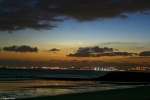 June s Young Crescent Moon
7.06.2008
Serene skyviews were enjoyed across planet Earth earlier this week with a young crescent Moon low in the western sky just after sunset. Recorded on June 4, this colorful example includes a quiet beach in the foreground with the city lights of Lisbon, Portugal, and the Sintra Mountains along the horizon.
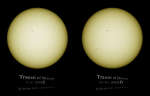 3D Mercury Transit
20.05.2016
On May 9, innermost planet Mercury crossed IN FRONT of the Sun. Though pictures project the event in only two dimensions, a remarkable three dimensional perspective on the transit is possible by free viewing this stereo pair.
|
January February March April May June July August September October |
|||||||||||||||||||||||||||||||||||||||||||||||||