
|
You entered: planet
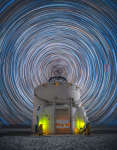 APOD: 2026 August 28 Б The Sky Turns Above Paranal
28.08.2026
At the latitude of ESO's Paranal Observatory in Chile, about 25 degrees south, Earth's rotation moves the planet's surface eastward at over 1,500 kilometers per hour. And while that's faster than the speed of sound at sea level, the motion is imperceptible.
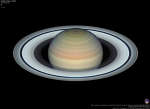 Saturn near Opposition
17.06.2017
Saturn reached its 2017 opposition on June 16. Of course, opposition means opposite the Sun in Earth's sky and near opposition Saturn is up all night, at its closest and brightest for the year.
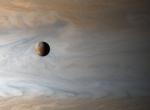 Io: Moon Over Jupiter
20.04.2001
How big is the Jovian moon Io? The most volcanic body in the Solar System, Io (usually pronounced "EYE-oh") is 3,600 kilometers in diameter, about the size of planet Earth's single large natural satellite.
 Saturn in the Hive
28.01.2006
If you can find Saturn in tonight's sky, then you can also find M44, popularly known as the Beehive star cluster. In fact, with a pair of binoculars most casual skygazers should find it fairly easy to zero in on this celestial scene.
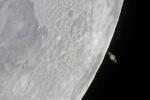 The Moon s Saturn
26.05.2007
On May 22nd, just days after sharing the western evening sky with Venus, the Moon moved on to Saturn - actually passing in front of the ringed planet when viewed in skies over Europe, northern Africa, and western Asia.
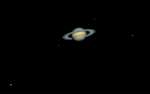 Six Moons of Saturn
14.04.2012
How many moons does Saturn have? So far 62 have been discovered, the smallest only a fraction of a kilometer across. Six of its largest satellites can be seen here, though, in a sharp Saturnian family portrait taken on March 9.
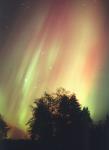 October Skylights
8.11.2000
With brilliant Venus above the western horizon at sunset and Jupiter and Saturn high in the east by early evening, November's night sky is filled with bright planets. October's sky featured bright planets as well and, triggered by the active Sun, some lovely auroral displays.
 APOD: 2025 August 21 Б Mostly Perseids
21.08.2025
In this predawn skyscape recorded during the early morning hours of August 13, mostly Perseid meteors are raining down on planet Earth. You can easily identify the Perseid meteor streaks. They're the ones...
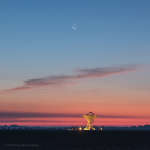 Moon, Mercury, and Twilight Radio
8.10.2016
Sharing dawn's twilight with the Moon on September 29, Mercury was about as far from the Sun as it can wander, the innermost planet close to its maximum elongation in planet Earth's skies.
 In Ganymede s Shadow
7.10.2022
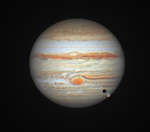
At opposition, opposite the Sun in Earth's sky, late last month Jupiter is also approaching perihelion, the closest point to the Sun in its elliptical orbit, early next year. That makes Jupiter exceptionally close to our fair planet, currently resulting in excellent views of the Solar System's ruling gas giant.
|
January February March April May June July August September October |
|||||||||||||||||||||||||||||||||||||||||||||||||