
|
You entered: planet
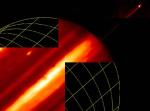 Jupiter: Moon, Ring, and Clouds
21.11.1997
An inner moon, an edge-on, planet-girdling ring, and high altitude cloud bands are visible in this mosaic of infrared images of gas giant Jupiter. The moon Metis, 25 miles wide and about 80,000 miles from the planet, is the bright spot at the upper right.
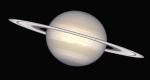 Natural Saturn On The Cassini Cruise
11.05.2002
What could you see approaching Saturn aboard an interplanetary cruise ship? Your view would likely resemble this subtly shaded image of the gorgeous ringed gas giant. Processed by the Hubble Heritage project, the picture...
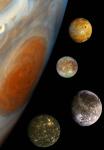 Jupiter And Family
29.09.1997
This composite image features classic portraits of members of one of the Solar System's most prominent families - Jupiter and its four large "Galilean" moons. Starting from the top the moons are Io, Europa, Ganymede, and Callisto. The top-to-bottom order is also the order of increasing distance from Jupiter.
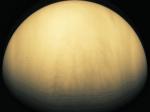 Venus: Earths Cloudy Twin
16.05.2004
This picture by the Galileo spacecraft shows just how cloudy Venus is. Venus is very similar to Earth in size and mass - and so is sometimes referred to as Earth's sister planet - but Venus has a quite different climate.
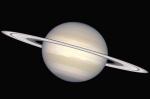 Natural Saturn On The Cassini Cruise
17.08.2003
What could you see approaching Saturn aboard an interplanetary cruise ship? Your view would likely resemble this subtly shaded image of the gorgeous ringed gas giant. Processed by the Hubble Heritage project, the picture...
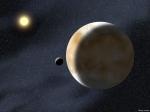 Eris: More Massive than Pluto
19.06.2007
Eris, a dwarf planet currently orbiting the Sun at about twice Pluto's distance, has been measured to have about 27 percent more mass than Pluto. The mass was calculated by timing the orbit of Eris' moon Dysnomia.
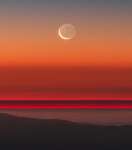 Old Moon in the New Moon s Arms
20.01.2018
Also known as the Moon's "ashen glow" or the "Old Moon in the New Moon's arms", earthshine is earthlight reflected from the Moon's night side. This stunning image of earthshine from a young crescent moon was taken from Las Campanas Observatory, Atacama Desert, Chile, planet Earth near moonset on January 18.
 Terran 1 Burns Methalox
6.04.2023
Relativity's Terran 1 Rocket is mostly 3D-printed. It burns a cryogenic rocket fuel composed of liquid methane and liquid oxygen (methalox). In this close-up of a Terran 1 launch on the night...
 APOD: 2025 January 15 Б Wolf Moon Engulfs Mars
15.01.2025
Does the Moon ever engulf Mars? Yes, but only in the sense that it moves in front, which happens on rare occasions. This happened just yesterday, though, as seen from some locations in North America and western Africa.
 APOD: 2025 May 25 Б Beneath Jupiter
25.05.2025
Jupiter is stranger than we knew. NASA's Juno spacecraft has now completed over 70 swoops past Jupiter as it moves around its highly elliptical orbit. Pictured from 2017, Jupiter is seen from below where, surprisingly, the horizontal bands that cover most of the planet disappear into swirls and complex patterns.
|
January February March April May June July August September October |
|||||||||||||||||||||||||||||||||||||||||||||||||