
|
You entered: planet
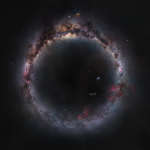 The Milky Ring
21.01.2021
An expanse of cosmic dust, stars and nebulae along the plane of our Milky Way galaxy form a beautiful ring in this projected all-sky view. The creative panorama covers the entire galaxy visible from planet Earth, an ambitious 360 degree mosaic that took two years to complete.
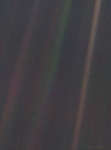 The Largest Rock in our Solar System
31.12.2022
There, that dot on the right, that's the largest rock known in our Solar System. It is larger than every known asteroid, moon, and comet nucleus. It is larger than any other local rocky planet.
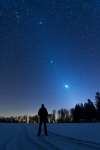 A Zodiacal Skyscape
23.02.2012
Venus and Jupiter are this month's two brightest planets. Shortly after sunset on February 20, they dominate the sky above the western horizon and this snowy landscape. In clear and transparent skies over Cherry Springs State Park, Pennsylvania, USA, they are also seen immersed in Zodiacal light.
 Between the Rings
21.04.2017
On April 12, as the Sun was blocked by the disk of Saturn the Cassini spacecraft camera looked toward the inner Solar System and the gas giant's backlit rings. At the top of the mosaicked view is the A ring with its broader Encke and narrower Keeler gaps visible.
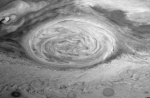 Galileo, Cassini, and the Great Red Spot
2.08.1996
Imagine a hurricane that lasted for 300 years! Jupiter's Great Red Spot indeed seems to be a giant hurricane-like storm system rotating with the Jovian clouds. Observed in 1655 by Italian-French astronomer Jean-Dominique Cassini it is seen here over 300 years later - still going strong - in a mosaic of recent Galileo spacecraft images.
 Infrared Saturn
21.02.2003
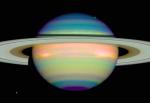
This delightfully detailed false-color image of Saturn was taken in January 1998 by the orbiting Hubble Space Telescope. The picture is a combination of three images from Hubble's NICMOS instrument and shows the lovely ringed planet in reflected infrared sunlight.
 Saturn: Light, Dark, and Strange
12.10.2010
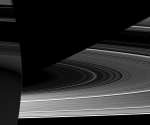
What's creating those dark bands on Saturn? Sometimes it takes a little sleuthing to figure out the how and why of a picture taken by the Saturn-orbiting Cassini spacecraft. Let's see. That large orb on the left must be Saturn itself. Those arcs on the right are surely the rings.
 Lantern Saturn
31.05.2012
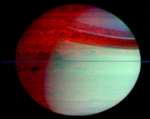
Known for its bright ring system and many moons, gas giant Saturn looks strange and unfamiliar in this false-color view from the Cassini spacecraft. In fact, in this Visual and Infrared Mapping Spectrometer (VIMS) mosaic the famous rings are almost invisible, seen edge-on cutting across picture center.
 Conjunction Colours
23.08.2012
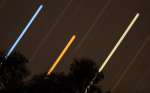
During the past week, nightfall on planet Earth has featured Mars, Saturn, and Spica in a lovely conjunction near the western horizon. Still forming the corners of a distinctive celestial triangle after sunset...
 Mars Perseverance Sol 3
25.02.2021
Stitched together on planet Earth, 142 separate images make up this 360 degree panorama from the floor of Jezero Crater on Mars. The high-resolution color images were taken by the Perseverance rover's zoomable Mastcam-Z during mission sol 3, also known as February 21, 2021.
|
January February March April May June July August September October |
|||||||||||||||||||||||||||||||||||||||||||||||||