
|
You entered: comet
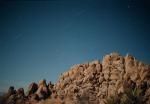 Leonids Over Indian Cove
18.11.2003
One year ago today an impressive meteor shower graced the skies of Earth. Pictured above from last year, at least six bright meteors are visible in only part of the sky above Indian Cove campground in California, USA, during a four-minute exposure.
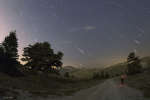 Perseid Meteors over Turkey
1.08.2017
The Perseid Meteor Shower, usually the best meteor shower of the year, will peak late next week. A person watching a clear sky from a dark location might see a bright meteor every minute.
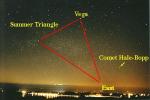 Vega
Vega
23.08.1998
Vega is a bright blue star 25 light years away. Vega is the brightest star in the Summer Triangle, a group of stars easily visible summer evenings in the northern hemisphere. The name Vega...
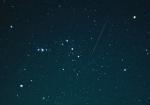 A 2000 Leonid Through Orion
20.11.2000
The Leonid Meteor Shower this year could be described as good but not great. During November 17 and 18 the Earth crossed through several streams of sand-sized grit left orbiting the Sun by Comet Tempel-Tuttle. Several distinct peaks in meteor activity were reported, with
 IRTF: Scanning the Infrared Skies
4.09.1996
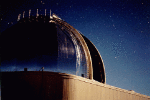
Above, NASA's Infrared Telescope Facility (IRTF) poses in front of a starry background. Located on top of Hawaii's towering volcano Mauna Kea, the IRTF is the premier telescope for observing in near infrared light. This 3-meter telescope was established in 1979 and spends about half its time observing Solar System objects.
 APOD: 2025 August 16 Б A Cool GIF of a 2025 Perseid
16.08.2025
The camera battery died about 2am local time on August 12, while shooting in the bright moonlit skies from a garden in Chastre, Brabant Wallon, Belgium, planet Earth. But not before it captured...
 A Wind From The Sun
18.03.2000
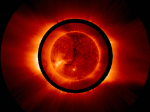
A wind from the Sun blows through our Solar System. The behaviour of comet tails as they flapped and waved in this interplanetary breeze gave astronomers the first hint of its existence. Streaming outward at 250-400 miles/second, electrons and ions boiling off the Sun's incredibly hot
 1999 Leonid Fireball
2.12.1999
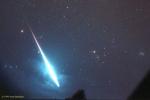
Most Leonid meteoroids, the bits of comet debris which produce the annual Leonid meteor shower, range from a mere millimeter to a centimeter in diameter. Yet these cosmic grains of sand and gravel can put on quite a spectacular show. How can something so small generate so much light?
 Big Dipper, Deep Sky
23.01.2016
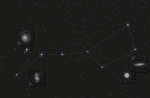
The Big Dipper is an easy to recognize, well-known asterism in northern skies, though many see the Plough or Wagon. Famous bright nebulae of the north can also be found along its familiar lines, highlighted in this carefully composed scene with telescopic insets framed in the wider-field skyview.
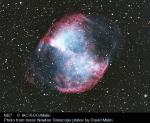 M27: The Dumbbell Nebula
18.02.1998
The first hint of what will become of our Sun was discovered inadvertently in 1764. At that time, Charles Messier was compiling a list of "annoying" diffuse objects not to be confused with "interesting" comets.
|
January February March April May June July August September October |
|||||||||||||||||||||||||||||||||||||||||||||||||