
|
You entered: comet
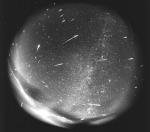 Leonids from Leo
8.12.1998
Is Leo leaking? Leo, the famous sky constellation visible on the left of the above all-sky photograph, appears to be the source of all the meteors seen in this year's Leonids Meteor Shower.
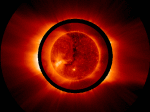 A Wind From The Sun
17.02.1997
A wind from the Sun blows through our Solar System. The behaviour of comet tails as they flapped and waved in this interplanetary breeze gave astronomers the first hint of its existence. Streaming outward...
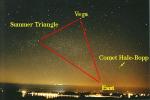 Vega
Vega
15.07.1997
Vega is a bright blue star 25 light years away. Vega is the brightest star in the Summer Triangle, a group of stars easily visible summer evenings in the northern hemisphere. The name Vega...
 The Largest Rock Known
1.01.1998
There, that faint dot in the center - that's the largest rock known. It is larger than every known asteroid, moon, and comet nucleus. It is larger than any other rocky planet. (Nobody knows...
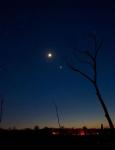 A Western Sky at Twilight
1.05.2004
On April 23rd, the Moon along with planets Saturn, Mars, and Venus (and planet Earth of course ...) were all visible in the west at twilight, captured here from a site near Saylorvillle Lake north of Des Moines, Iowa, USA.
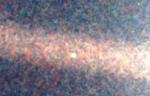 The Largest Rock Known
2.01.2000
There, that faint dot in the center - that's the largest rock known. It is larger than every known asteroid, moon, and comet nucleus. It is larger than any other rocky planet. (Nobody knows...
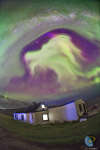 Goat Aurora Over Greenland
3.10.2012
Sometimes it's hard to believe what you see in the sky. During the Shelios Expedition to Greenland in late August, even veteran sky enthusiasts saw auroras so colorful, so fast changing, and so unusual in form that they could remember nothing like it.
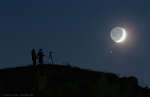 The Hill, The Moon, and Saturn
16.11.2018
Last Sunday when the Moon was young its sunlit crescent hung low near the western horizon at sunset. With strong earthshine it was joined by Saturn shining in the early evening sky for a beautiful conjunction visible to skygazers around our fair planet.
 Messier 2
4.04.2019
After the Crab Nebula, M1, this giant star cluster is the second entry in 18th century astronomer Charles Messier's famous list of things with are not comets. M2 is one of the largest globular star clusters now known to roam the halo of our Milky Way galaxy.
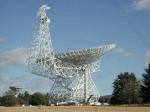 The 100 Meter Green Bank Radio Telescope
11.03.2002
The largest single-dish fully steerable radio telescope began operation in 2000 August in Green Bank, West Virginia, USA. Dedicated as the Robert C. Byrd Green Bank Telescope, the device weighs over 30 times more than the Statue of Liberty, and yet can point anywhere in the sky more precisely than one thousandth of a degree.
|
January February March April May June July August September October |
|||||||||||||||||||||||||||||||||||||||||||||||||