
|
You entered: comet
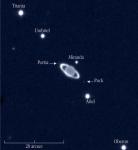 Ringed Planet Uranus
15.01.2003
Yes it does look like Saturn, but Saturn is one of only four giant ringed planets in our Solar System. And while Saturn has the brightest rings, this system of rings and moons actually belongs to planet Uranus, imaged here in near-infrared light by the Antu telescope at the ESO Parnal Observatory in Chile.
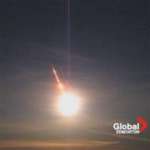 Fireball Over Edmonton
25.11.2008
What if you're driving down the street and an object from space shoots across the sky right in front of you? Such was the case last week for many people in south central Canada.
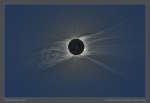 Total Solar Eclipse 2020
7.01.2021
Along a narrow path crossing southern South America through Chile and Argentina, the final New Moon of 2020 moved in front of the Sun on December 14 in the year's only total solar eclipse.
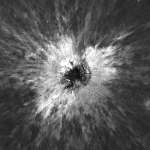 APOD: 2026 September 23 Б A New Lunar Crater: McGetchin
23.09.2026
A once-in-a-lifetime crater has appeared on the Moon! A comet or asteroid roughly the size of a humpback whale (approximately 10-20 meters, 30-60 feet) crashed into the Moon sometime between April and May of 2024.
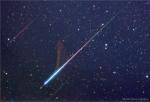 Fireball, Smoke Trail, Meteor Storm
22.11.2001
Returning from orbit, space shuttles enter the atmosphere at about 8 kilometers per second as friction heats their protective ceramic tiles to over 1,400 degrees Celsius. By contrast, the bits of comet dust...
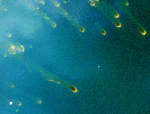 Cometary Knots in the Helix Nebula
16.04.1996
Four hundred fifty light-years from Earth, the wind from a dying, sun-like star produced a planetary nebula popularly known as the Helix. While exploring the Helix's gaseous envelope with the Hubble Space Telescope (HST), astronomers discovered indications of 1,000s of striking "cometary knots" like those shown above.
 Help Search for Interstellar Dust
25.10.2006
What caused that hole? The hole in question appears as a small dark circle on the far right. If the above image of aerogel seems dull and uninteresting, then welcome to one aspect of real world science.
 A Close Encounter Of The Stellar Kind
7.07.2001
The unassuming star centered in this sky view will one day be our next door stellar neighbor. The faint 9th magnitude red dwarf, currently 63 light-years away in the constellation Ophiucus, was recently discovered to be approaching our Solar System.
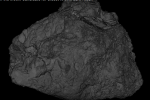 Found on the Moon: Candidate for Oldest Known Earth Rock
3.02.2021
Was the oldest known rock on Earth found on the Moon? Quite possibly. The story opens with the Apollo 14 lunar mission. Lunar sample 14321, a large rock found in Cone crater by astronaut...
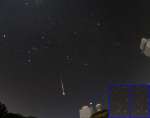 Leonid Fireball over Tenerife
22.11.2011
Historically active, this year's Leonid meteor shower was diminished by bright moonlight. Still, faithful night sky watchers did see the shower peak on November 18 and even the glare of moonlight didn't come close to masking this brilliant fireball meteor.
|
January February March April May June July August September October |
|||||||||||||||||||||||||||||||||||||||||||||||||