
|
You entered: comet
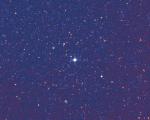 A Close Encounter Of The Stellar Kind
11.12.1999
The unassuming star centered in this sky view will one day be our next door stellar neighbor. The faint 9th magnitude red dwarf, currently 63 light-years away in the constellation Ophiucus, was recently discovered to be approaching our Solar System.
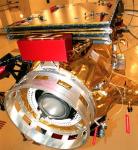 Full Throttle For Deep Space 1
22.09.2001
At full throttle the Deep Space 1 spacecraft's innovative ion drive produces about 1/50th of a pound of thrust ... a force so great that it would just about hold up a piece of paper on planet Earth! Still, powered by solar arrays ion propulsion systems can run continuously.
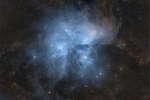 Messier 45: The Daughters of Atlas and Pleione
5.01.2023
Hurtling through a cosmic dust cloud a mere 400 light-years away, the lovely Pleiades or Seven Sisters open star cluster is well-known for its striking blue reflection nebulae. It lies in the night sky toward the constellation Taurus and the Orion Arm of our Milky Way galaxy.
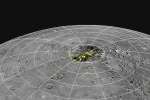 Northern Mercury
1.12.2012
Innermost planet Mercury would probably not be a good location for an interplanetary winter olympics. But new results based on data from the Mercury orbiting MESSENGER spacecraft indicate that it does have substantial water ice in permanently shadowed regions within craters near its north pole.
 When Z is for Mars
15.04.2023
A composite of images captured about a week apart from mid August 2022 through late March 2023, this series traces the retrograde motion of ruddy-colored Mars. Progressing from lower right to upper left Mars...
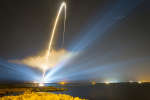 Parker vs Perseid
16.08.2018
The brief flash of a bright Perseid meteor streaks across the upper right in this composited series of exposures made early Sunday morning near the peak of the annual Perseid meteor shower.
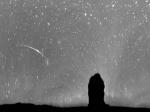 A Taurid Meteor Fireball
15.11.2005
Have you ever seen a very bright meteor? Unexpected, this year's Taurid meteor shower resulted in numerous reports of very bright fireballs during the nights surrounding Halloween. Pictured above, a fireball that momentarily rivaled the brightness of the full Moon was caught over Cerro Pachon, Chile by a continuous sky monitor on November 1.
 A Close Encounter of the Stellar Kind
26.06.1997
The unassuming star centered in this sky view will one day be our next door stellar neighbor. The faint 9th magnitude red dwarf currently 63 light-years away in the constellation Ophiucus was recently discovered to be on a course toward our Solar System.
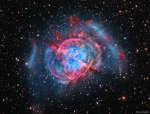 M27: The Dumbbell Nebula
3.12.2019
Is this what will become of our Sun? Quite possibly. The first hint of our Sun's future was discovered inadvertently in 1764. At that time, Charles Messier was compiling a list of diffuse objects not to be confused with comets.
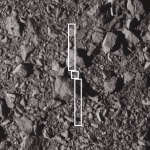 DART vs Dimorphos
9.03.2023
On the first planetary defense test mission from planet Earth, the DART spacecraft captured this close-up on 26 September 2022, three seconds before slamming into the surface of asteroid moonlet Dimorphos. The spacecraft's outline with two long solar panels is traced at its projected point of impact between two boulders.
|
January February March April May June July August September October |
|||||||||||||||||||||||||||||||||||||||||||||||||