
|
You entered: comet
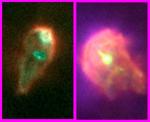 Protoplanetary Survivors in Orion
4.05.2001
The Orion Nebula is a nuturing stellar nursery filled with hot young stars and their natal clouds of gas and dust. But for planetary systems, the active star-forming region can present a hazardous and inhospitable birthplace.
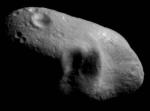 NEAR Shoemaker Views Eros
11.02.2001
Orbiting asteroid 433 Eros, 145 million miles from Earth, NASA's NEAR spacecraft has been returning stunning views as its year long mission of exploration nears completion. A mosaic of NEAR images recorded at a range of about 127 miles, this picture illustrates some of the amazing
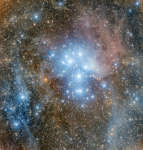 Messier 45: The Daughters of Atlas and Pleione
7.11.2019
Hurtling through a cosmic dust cloud a mere 400 light-years away, the lovely Pleiades or Seven Sisters open star cluster is well-known for its striking blue reflection nebulae. It lies in the night sky toward the constellation Taurus and the Orion Arm of our Milky Way Galaxy.
 Quadrantids
9.01.2019
Named for a forgotten constellation, the Quadrantid Meteor Shower is an annual event for planet Earth's northern hemisphere skygazers It usually peaks briefly in the cold, early morning hours of January 4. The shower's radiant on the sky lies within the old, astronomically obsolete constellation Quadrans Muralis.
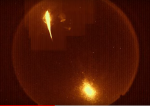 Meteor Fireballs in Light and Sound
15.03.2021
Yes, but have you ever heard a meteor? Usually, meteors are too far away to make any audible sound. However, a meteor will briefly create an ionization trail that can reflect a distant radio signal. If the geometry is right, you may momentarily hear -- through your radio -- a distant radio station even over static.
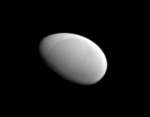 Methone: Smooth Egg Moon of Saturn
6.11.2012
Why is this moon shaped like a smooth egg? The robotic Cassini spacecraft completed the first flyby ever of Saturn's small moon Methone in May and discovered that the moon has no obvious craters.
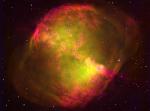 The Dumbbell Nebula in Hydrogen and Oxygen
13.01.2003
The first hint of what will become of our Sun was discovered inadvertently in 1764. At that time, Charles Messier was compiling a list of "annoying" diffuse objects not to be confused with "interesting" comets.
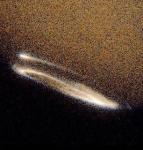 Jovian Aurora
23.01.1998
These two recently released Hubble Space Telescope close-ups show the Northern and Southern lights ... on Jupiter. Like aurora on Earth, these Jovian aurora are caused by charged particles funneled into the atmosphere above the planet's North (right) and South poles by magnetic fields.
 Asteroid 2004 FH Whizzes By
22.03.2004
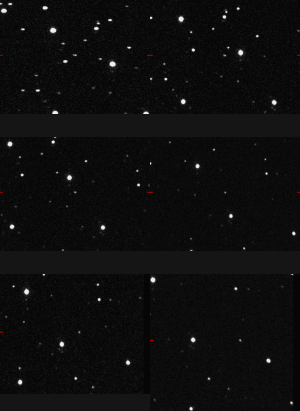
Last week, a small asteroid approached unusually close to the Earth. Asteroid 2004 FH posed no danger, but became bright enough to see with binoculars. Passing only 7 Earth radii away, this asteroid pass was the closest yet that was previously predicted, although it was discovered only two days before.
 The Ghosts of Cassiopeia
25.10.2019
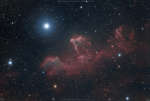
These bright rims and flowing shapes look ghostly on a cosmic scale. A telescopic view toward the constellation Cassiopeia, the colorful skyscape features swept-back, comet-shaped clouds IC 59 (left) and IC 63. About 600 light-years distant, the clouds aren't actually ghosts.
|
January February March April May June July August September October |
|||||||||||||||||||||||||||||||||||||||||||||||||