
|
You entered: Europa
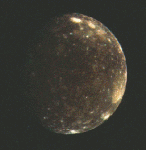 Callisto: Dark Smashed Iceball
6.09.1995
Callisto is a dirty battered world, showing the most beaten surface of Jupiter's major moons. Made of a rocky core covered by fractured ice, Callisto's past collisions with large meteors are evident as large craters surrounded by concentric rings.
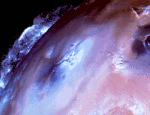 Erupting Volcanoes on Io
5.08.1996
Jupiter's moon Io has active volcanoes. The Voyager spacecraft caught several erupting when they passed the energetic moon in 1979. In the above picture, several of Io's volcanoes are visible and one is seen actually erupting.
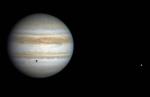 Cassini Spacecraft Approaches Jupiter
11.10.2000
A new spacecraft has entered the outer Solar System: Cassini. Launched in 1997 and bound for Saturn in 2004, Cassini sent back the above image last week while approaching the giant planet Jupiter. Cassini joins the Galileo spacecraft currently in orbit around Jupiter in studying the gas giant and its moons.
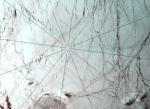 North Pole Below
20.10.2000
Orbiting over the north pole of planet Earth on May 5, the MODIS instrument on-board the Terra spacecraft, recorded this view of the ice cap 700 kilometers below. A radial grid centered on the pole is shown on top of the approximately true color image where each pixel covers about one square kilometer.
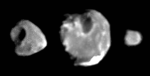 Jupiters Moons Thebe, Amalthea, and Metis
8.05.2000
The robot spacecraft Galileo in orbit around Jupiter has recently photographed the inner moons of Jupiter in greater detail than ever before. These pictures of Thebe, Amalthea, and Metis are shown to scale, and reveal details as small as three kilometers across. Amalthea, by contrast, has a total length of about 200 kilometers.
 APOD: 2025 August 23 Б Fishing for the Moon
22.08.2025
How big is planet Earth's Moon? Compared to other moons of the Solar System, it's number 5 on the largest to smallest ranked list, following Jupiter's moon Ganymede, Saturn's moon Titan, and Jovian moons Callisto and Io. Continuing the list, the Moon comes before Jupiter's Europa and Neptune's Triton.
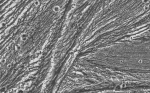 Galileo Photographs Ganymede
10.07.1996
Ganymede's surface is slowly being pulled apart. This photo of Ganymede was released earlier today by the Galileo team at NASA. The Galileo Spacecraft arrived at Jupiter in December 1995. In late June...
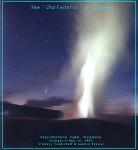 Old Faithful Meets Hale-Bopp
26.05.1997
As Comet Hale-Bopp leaves our Northern Skies, it provides us with yet another burst of joy. On May 11th the fading comet was photographed behind the famous "Old Faithful" water geyser of Yellowstone National Park, Wyoming, USA, Planet Earth.
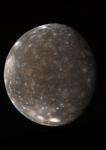 Oceans Under Jupiters Callisto
31.07.2001
Why does Jupiter's moon Callisto alter the magnetic field of Jupiter in its vicinity? Callisto itself does not have a strong magnetic field. One possible answer is that Callisto harbors sub-surface oceans of electrically conducting salt-water. This hypothesis was bolstered recently by a new analysis of how Callisto creates and dissipates heat.
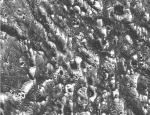 Ancient Cratered Plains on Ganymede
12.07.1996
The largest moon in the Solar System shows regions that are ancient and battered. The high density of craters demonstrate that patches of Ganymede are indeed billions of years old. This photo is one of a series released by NASA two days ago from the Galileo spacecraft orbiting Jupiter.
|
January February March April May June July August September |
|||||||||||||||||||||||||||||||||||||||||||||||||