
|
You entered: Europa
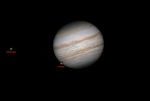 Jupiter Rotates as Moons Orbit
25.10.2022
Jupiter and its moons move like our Sun and its planets. Similarly, Jupiter spins while its moons circle around. JupiterБs rotation can be observed by tracking circulating dark belts and light zones. The Great Red Spot, the largest storm known, rotates to become visible after about 15 seconds in the 48-second time lapse video.
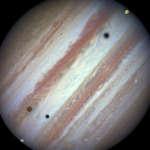 Jupiter Triple Moon Conjunction
5.02.2015
Our solar system's ruling giant planet Jupiter and 3 of its 4 large Galilean moons are captured in this single Hubble snapshot from January 24. Crossing in front of Jupiter's banded cloud tops Europa, Callisto, and Io are framed from lower left to upper right in a rare triple-moon conjunction.
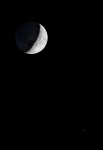 Jupiter and the Moons
5.10.2019
After sunset on October 3, some of the Solar System's largest moons stood low along the western horizon with the largest planet. Just after nightfall, a pairing of the Moon approaching first quarter phase and Jupiter was captured in this telephoto field of view.
 APOD: 2025 September 1 Б Callisto: Dirty Battered Iceball
1.09.2025
Its surface is the most densely cratered in the Solar System -- but what's inside? Jupiter's moon Callisto is a battered ball of dirty ice that is larger than the planet Mercury.
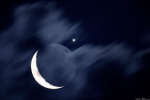 Moon Meets Jupiter
10.07.2016
What's that next to the Moon? Jupiter -- and its four largest moons. Skygazers around planet Earth enjoyed the close encounter of planets and Moon in 2012 July 15's predawn skies. And while...
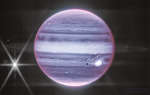 Jupiter and Ring in Infrared from Webb
20.07.2022
Why does Jupiter have rings? Jupiter's main ring was discovered in 1979 by NASA's passing Voyager 1 spacecraft, but its origin was then a mystery. Data from NASA's Galileo spacecraft that...
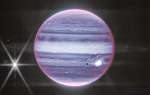 APOD: 2025 April 2 Б Jupiter and Ring in Infrared from Webb
2.04.2025
Why does Jupiter have rings? Jupiter's main ring was discovered in 1979 by NASA's passing Voyager 1 spacecraft, but its origin was then a mystery. Data from NASA's Galileo spacecraft that...
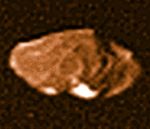 Jupiter's Moon Amalthea
3.11.1995
Amalthea is Jupiter's fifth largest moon, much smaller than the four Galilean satellites Io, Europa, Ganymede, and Callisto. The orbit of Amalthea is inside of these moons, and with its long axis always pointing toward Jupiter. It's dark surface color is probably due to sulfur being expelled from Io.
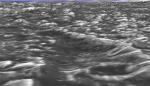 The Hills of Ganymede
23.12.1996
This computer generated 3D close-up view of Jupiter's large moon Ganymede was created using image data from NASA's Galileo spacecraft. Simulating stereo vision by combining two recent images recorded from different angles, 3 dimensional information was reconstructed for a section of Ganymede's surface.
 A Flyby View of Ganymede
25.10.1996
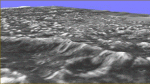
This is what it would look like to fly over the surface of Jupiter's moon Ganymede. NASA's robot spacecraft Galileo recently approached only 6000 miles from this frozen ice-ball of a moon. The above image is a digital reconstruction from two images taken during this flyby.
|
January February March April May June July August September |
|||||||||||||||||||||||||||||||||||||||||||||||||