
|
You entered: astronomer
 APOD: 2025 August 4 Б Blue Arcs Toward Andromeda
4.08.2025
What are these gigantic blue arcs near the Andromeda Galaxy (M31)? Discovered in 2022 by amateur astronomers, the faint arcs -- dubbed SDSO 1 -- span nearly the same angular size as M31 itself. At first, their origin was a mystery: are they actually near the Andromeda Galaxy, or alternatively near to our Sun?
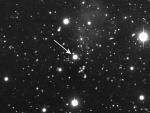 QSO H1821 643 Indicates a Universe Filled with Hydrogen
16.05.2000
A quasar slightly depleted of a specific color of light may indicate that our universe is filled with massive amounts of ionized hydrogen. Light from QSO H1821+643, pictured above, comes to us from about a quarter of the way across the visible universe.
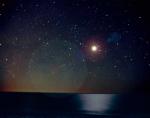 1006 AD: Supernova in the Sky
30.04.2006
A new star, likely the brightest supernova in recorded human history, appeared in planet Earth's sky about 1,000 years ago today, in 1006 AD. The expanding debris cloud from the stellar explosion is still visible to modern astronomers, but what did the supernova look like in 1006?
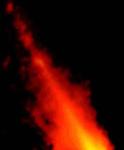 Rings Around Beta Pictoris
8.02.2000
An unusual dust disk surrounds nearby star Beta Pictoris. Discovered in 1983, astronomers are still learning just how unusual this disk is. Recent images and computer simulations indicate that the disk contains several elliptical dust rings larger than our own Solar System.
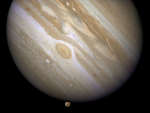 Jupiter Eclipsing Ganymede
6.01.2009
How hazy is Jupiter's upper atmosphere? To help find out, astronomers deployed the Hubble Space Telescope to watch Jupiter eclipse its moon Ganymede. Although Ganymede circles Jupiter once a week, it usually passes above or below the planet, so that a good eclipse occurs more rarely.
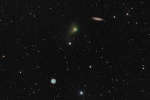 The Comet, the Owl, and the Galaxy
21.04.2016
Comet C/2014 S2 (PanSTARRS) poses for a Messier moment in this telescopic snapshot from April 18. In fact it shares the 1.5 degree wide field-of-view with two well-known entries in the 18th century comet-hunting astronomer's famous catalog.
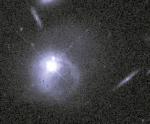 A Quasar-Galaxy Collision?
22.10.1995
In 1963 astronomers were astounded to discover that certain faint, star-like objects have very large redshifts. The large redshifts imply that these objects, now known as quasars (QUASi-stellAR objects), lie near the edge of the observable Universe.
 Unexpected Impact on Jupiter
8.09.2009
Two months ago, something unexpected hit Jupiter. First discovered by an amateur astronomer Anthony Wesley on 2009 July 19, the impact was quickly confirmed and even imaged by the Hubble Space Telescope the very next day.
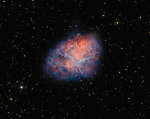 M1: The Crab Nebula
20.11.2014
The Crab Nebula is cataloged as M1, the first object on Charles Messier's famous 18th century list of things which are not comets. In fact, the Crab is now known to be a supernova remnant, debris from the death explosion of a massive star, witnessed by astronomers in the year 1054.
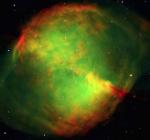 M27: Not A Comet
2.03.2002
While searching the skies above 18th century France for comets, astronomer Charles Messier diligently recorded this object as number 27 on his list of things which are definitely not comets. So what is it?
|
January February March April May June July August September |
|||||||||||||||||||||||||||||||||||||||||||||||||