
|
You entered: astronomer
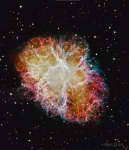 APOD: 2025 December 29 Б M1: The Crab Nebula
29.12.2025
This is the mess that is left when a star explodes. The Crab Nebula, the result of a supernova seen in 1054 AD, is filled with mysterious filaments. The filaments are not only tremendously...
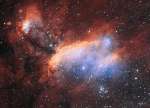 IC 4628: The Prawn Nebula
23.09.2013
South of Antares, in the tail of the nebula-rich constellation Scorpius, lies emission nebula IC 4628. Nearby hot, massive stars, millions of years young, radiate the nebula with invisible ultraviolet light, stripping electrons from atoms. The electrons eventually recombine with the atoms to produce the visible nebular glow, dominated by the red emission of hydrogen.
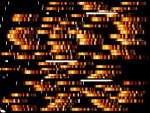 Breaking Distant Light
4.01.2009
In the distant universe, time appears to run slow. Since time-dilated light appears shifted toward the red end of the spectrum (redshifted), astronomers are able to use cosmological time-slowing to help measure vast distances in the universe.
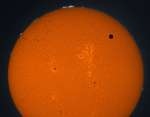 Venus Transit 2012
7.06.2012
Occurring in pairs separated by over a hundred years, there have now been only eight transits of Venus since the invention of the telescope in 1608. The next will be in December of 2117.
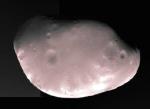 Deimos: A Small Martian Moon
15.11.1998
Mars has two tiny moons, Phobos and Deimos. Pictured above is Deimos, the smaller moon of Mars. In fact, Deimos is one of the smallest known moons in the Solar System measuring only 9 miles across.
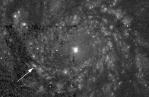 A Supernova in the Whirlpool
21.04.1996
In 1994, a new star in a distant galaxy was seen by amateur astronomers, who alerted the world to their discovery of a supernova. Near the nucleus of spiral galaxy M51, popularly known...
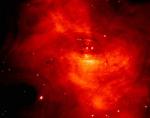 The Pulsar Powered Crab
2.06.2001
In the Summer of 1054 A.D. Chinese astronomers reported that a star in the constellation of Taurus suddenly became as bright as the full Moon. Fading slowly, it remained visible for over a year.
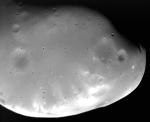 Deimos: A Small Martian Moon
4.01.2004
Mars has two tiny moons, Phobos and Deimos. Pictured above is Deimos, the smaller moon of Mars. In fact, Deimos is one of the smallest known moons in the Solar System measuring only nine miles across.
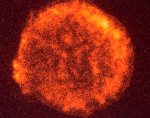 Tychos Supernova Remnant in X ray
7.03.1999
How often do stars explode? By looking at external galaxies, astronomers can guess that these events, known as a supernovae, should occur about once every 30 years in a typical spiral galaxy like our MilkyWay.
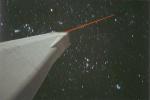 Space Laser Creates Artificial Star
25.04.2001
Some astronomers don't like stars. Bright star fluctuations can indicate how the Earth's atmosphere is changing, but many times no bright star exists in the direction where atmospheric information is needed.
|
January February March April May June July August September |
|||||||||||||||||||||||||||||||||||||||||||||||||