
|
You entered: astronomer
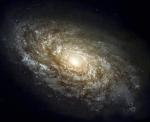 NGC 4414: A Telling Spiral
9.06.1999
How far away is this galaxy? Cosmologists the world over have been working hard to find out. Spiral galaxy NGC 4414 contains many Cepheid variable stars that oscillate in a way that allows astronomers to estimate their distance.
 A Dark Seahorse in Cepheus
7.11.2025
Spanning light-years, this suggestive shape known as the Seahorse Nebula floats in silhouette against a rich background of stars and glowing hydrogen gas. Seen toward the royal northern constellation of Cepheus, the dusty, dark nebula is part of a Milky Way molecular cloud some 1,200 light-years distant.
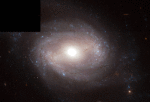 Hubble's Constant And The Expanding Universe (II)
14.05.1996
In this century, the discovery that the Universe is expanding has produced a revolution in human thought about the Cosmos. American astronomer Edwin Hubble played a major role in this profound discovery, coining the "Hubble constant".
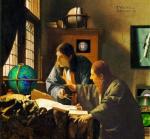 APOD Is Ten Years Old Today
16.06.2005
Welcome to the eleventh year of Astronomy Picture of the Day! In a decade of editing the APOD web pages, the industrious Robert Nemiroff (left) and persistent Jerry Bonnell (right) have enjoyed exploring compelling...
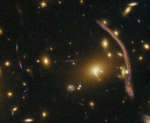 Abell 370: Galaxy Cluster Gravitational Lens
21.09.2009
What is that strange arc? While imaging the cluster of galaxies Abell 370, astronomers had noted an unusual arc to the right of many cluster galaxies. Although curious, one initial response was to avoid commenting on the arc because nothing like it had ever been noted before.
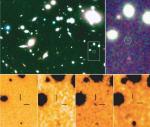 Redshift 10: Evidence for a New Farthest Galaxy
17.03.2004
What's the farthest galaxy known? The answer keeps changing as astronomers compete to find galaxies that top the list. The new claimed record holder is now the faint smudge indicated in the above images by an 8.2-meter Very Large Telescope (VLT) operating in Chile.
 Lynds Dark Nebula 43
30.10.2025
Sure, Halloween is an astronomy holiday. But astronomers always enjoy scanning the heavens for spook-tacular galaxies, stars, and nebulae. This favorite is item number 43 from the Beverly Lynds 1962 Catalog of Dark Nebulae, fondly known as the Cosmic Bat nebula.
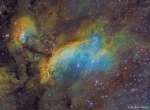 IC 4628: The Prawn Nebula
4.07.2016
South of Antares, in the tail of the nebula-rich constellation Scorpius, lies emission nebula IC 4628. Nearby hot, massive stars, millions of years young, radiate the nebula with invisible ultraviolet light, stripping electrons from atoms. The electrons eventually recombine with the atoms to produce the visible nebular glow, dominated by the red emission of hydrogen.
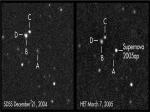 SN 2005ap: The Brightest Supernova Yet Found
16.10.2007
What could cause a bang this big? This supernova explosion was so inherently bright that it could be seen nearby 5 billion light years away (a redshift of 0.28) even with a small telescope.
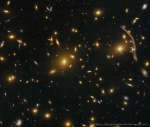 Abell 370: Galaxy Cluster Gravitational Lens
28.08.2016
What is that strange arc? While imaging the cluster of galaxies Abell 370, astronomers had noted an unusual arc to the right of many cluster galaxies. Although curious, one initial response was to avoid commenting on the arc because nothing like it had ever been noted before.
|
January February March April May June July August September |
|||||||||||||||||||||||||||||||||||||||||||||||||