
|
You entered: astronomer
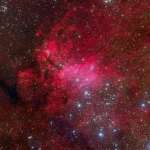 IC 4628: The Prawn Nebula
7.09.2012
South of Antares, in the tail of the nebula-rich constellation Scorpius, lies emission nebula IC 4628. Nearby hot, massive stars, millions of years young, radiate the nebula with invisible ultraviolet light, stripping electrons from atoms. The electrons eventually recombine with the atoms to produce the visible nebular glow, dominated by the red emission of hydrogen.
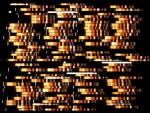 Breaking Distant Light
19.03.2002
In the distant universe, time appears to run slow. Since time-dilated light appears shifted toward the red end of the spectrum (redshifted), astronomers are able to use cosmological time-slowing to help measure vast distances in the universe.
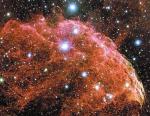 Galactic Supernova Remnant IC 443
3.09.2003
About 8000 years ago, a star in our Galaxy exploded. Ancient humans might have noticed the supernova as a temporary star, but modern humans can see the expanding shell of gas even today. Pictured...
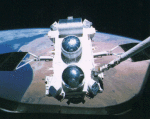 The Compton Gamma Ray Observatory
11.08.1995
The Compton Gamma Ray Observatory (CGRO) was the most massive instrument ever launched by a NASA Space Shuttle and continues to revolutionize gamma-ray astronomy. This orbiting observatory sees the sky in gamma-ray photons - light so blue humans can't see it.
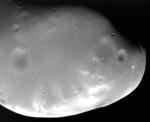 Deimos: A Small Martian Moon
2.09.2001
Mars has two tiny moons, Phobos and Deimos. Pictured above is Deimos, the smaller moon of Mars. In fact, Deimos is one of the smallest known moons in the Solar System measuring only nine miles across.
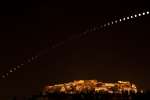 Eclipse over the Acropolis
25.06.2011
The total phase of the June 15 lunar eclipse lasted an impressive 100 minutes. Its entire duration is covered in this composite of a regular sequence of digital camera exposures, tracking the dark lunar disk as it arced above the Acropolis in Athens, Greece.
 Breaking Distant Light
20.09.2020
In the distant universe, time appears to run slowly. Since time-dilated light appears shifted toward the red end of the spectrum (redshifted), astronomers are able to use cosmological time-slowing to help measure vast distances in the universe.
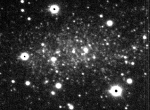 The Closest Galaxy: The Sagittarius Dwarf
4.02.1996
What's the closest galaxy to our Milky Way? For many years astronomers thought it was the Large Magellanic Cloud (LMC). But the seemingly insignificant fuzzy patch shown above turned out to be part of a galaxy that is even closer.
 The Closest Galaxy: The Sagittarius Dwarf
29.03.1997
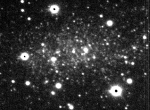
What's the closest galaxy to our Milky Way? For many years astronomers thought it was the Large Magellanic Cloud (LMC). But the seemingly insignificant fuzzy patch shown above turned out to be part of a galaxy that is even closer.
 Deimos: Small Martian Moon
3.10.1995
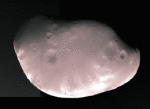
Mars has two tiny moons, Phobos and Deimos. Pictured above is Deimos, the smallest moon of Mars. In fact, Deimos is the smallest known moon in the Solar System measuring only 9 miles across.
|
January February March April May June July August September |
|||||||||||||||||||||||||||||||||||||||||||||||||