
|
You entered: wind
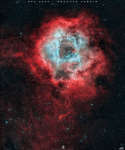 Roses are Red
14.02.2026
Roses are red, nebulas are too, and this Valentine's gift is a stunning view! Pictured is a loving look at the Rosette Nebula (NGC 2237): a cosmic bloom of bright young stars sitting atop a stem of glowing hot gas.
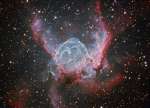 Thor s Helmet
5.06.2010
This helmet-shaped cosmic cloud with wing-like appendages is popularly called Thor's Helmet. Heroically sized even for a Norse god, Thor's Helmet is about 30 light-years across. In fact, the helmet is actually...
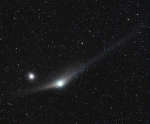 Comet Garradd and M92
4.02.2012
Sweeping slowly through the constellation Hercules, Comet Garradd (C2009/P1) passed with about 0.5 degrees of globular star cluster M92 on February 3. Captured here in its latest Messier moment, the steady performer remains just below naked-eye visibility with a central coma comparable in brightness to the dense, well-known star cluster.
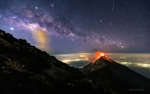 A Volcano of Fire under a Milky Way of Stars
27.05.2019
Sometimes it's hard to decide which is more impressive -- the land or the sky. On the land of the featured image, for example, the Volcano of Fire (VolcАn de Fuego) is seen erupting topped by red-hot, wind-blown ash and with streams of glowing lava running down its side.
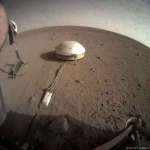 SEIS: Listening for Marsquakes
4.06.2019
If you put your ear to Mars, what would you hear? To find out, and to explore the unknown interior of Mars, NASA's Insight Lander deployed SEIS late last year, a sensitive seismometer that can detect marsquakes.
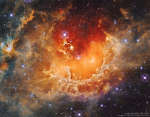 Star Formation in the Tadpole Nebula
28.01.2020
What's all of the commotion in the Tadpole Nebula? Star formation. Dusty emission in the Tadpole Nebula, IC 410, lies about 12,000 light-years away in the northern constellation of the Charioteer (Auriga).
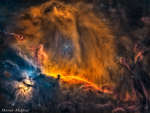 A Lion in Orion
7.03.2022
Yes, but can you see the lion? A deep exposure shows the famous dark indentation that looks like a horse's head, visible just left and below center, and known unsurprisingly as the Horsehead Nebula. The Horsehead Nebula (Barnard 33) is part of a vast complex of dark absorbing dust and bright glowing gas.
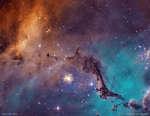 N11: Star Clouds of the LMC
12.04.2022
Massive stars, abrasive winds, mountains of dust, and energetic light sculpt one of the largest and most picturesque regions of star formation in the Local Group of Galaxies. Known as N11, the region...
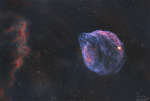 APOD: 2023 March 29 Б Sh2-308: A Dolphin Shaped Star Bubble
29.03.2023
Which star created this bubble? It wasn't the bright star on the bubble's right. And it also wasn't a giant space dolphin. It was the star in the blue nebula's center, a famously energetic Wolf-Rayet star.
 Hydrogen Clouds of M33
30.01.2025
Gorgeous spiral galaxy Messier 33 seems to have more than its fair share of glowing hydrogen gas. A prominent member of the local group of galaxies, M33 is also known as the Triangulum Galaxy and lies a mere 3 million light-years away.
|
January February March April May June July August September October |
|||||||||||||||||||||||||||||||||||||||||||||||||