
|
You entered: background
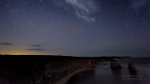 Southern Ocean Sky
4.07.2011
Clouds and sky both show illuminating changes during this time lapse video from the south of Australia. In the foreground are scenes visible over a rocky coastline toward the Southern Ocean. Dark clouds flow...
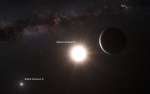 A View from Next Door
18.10.2012
Located just next door, Alpha Centauri is the closest star system to the Sun. A view from our interstellar neighbor a mere 4.3 light-years away is shown in this illustration. The Sun is at the upper right, a bright star against the background of the Milky Way.
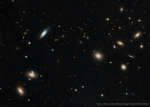 Inside the Coma Cluster of Galaxies
28.02.2015
Almost every object in the above photograph is a galaxy. The Coma Cluster of Galaxies pictured above is one of the densest clusters known - it contains thousands of galaxies. Each of these galaxies houses billions of stars - just as our own Milky Way Galaxy does.
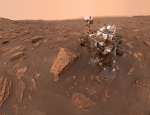 Curiosity s Dusty Self
23.06.2018
Winds on Mars can't actually blow spacecraft over. But in the low gravity, martian winds can loft fine dust particles in planet-wide storms, like the dust storm now raging on the Red Planet.
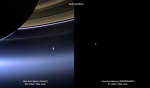 APOD: 2026 June 13 Б Interplanetary Earth
13.06.2026
In an interplanetary first, on July 19, 2013 Earth was photographed on the same day from two other worlds of the Solar System, innermost planet Mercury and ringed gas giant Saturn. Pictured...
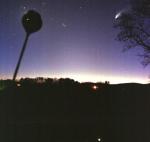 A Hale-Bopp Triple Crown
23.07.1997
It was truly a busy sky. In one of the more spectacular photos yet submitted to Astronomy Picture of the Day, Don Cooke of Lyme, New Hampshire caught the Sun, Moon, Earth, night sky, Pleiades star cluster, and Comet Hale-Bopp all in one frame.
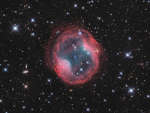 Jones Emberson 1
24.02.2023
Planetary nebula Jones-Emberson 1 is the death shroud of a dying Sun-like star. It lies some 1,600 light-years from Earth toward the sharp-eyed constellation Lynx. About 4 light-years across, the expanding remnant...
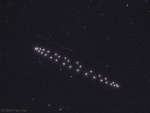 APOD: 2026 May 6 Б The Retrograde Dance of Saturn and Neptune
6.05.2026
What does it mean for Saturn and Neptune to be in retrograde? Featured is a composite of images taken over 34 nights from May 2025 to February 2026 tracing Saturn (brighter, foreground) and Neptune (dimmer, background). Over that time, the two planets exhibited retrograde motion, meaning they appeared to move backward in the sky.
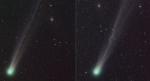 Comet C 2001 Q4 (NEAT)
23.04.2004
Inbound from the distant solar system, comet C/2001 Q4 will soon pass just inside planet Earth's orbit and should be one of two bright, naked-eye comets visible in southern skies in May. First...
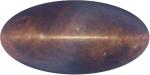 The Far Infrared Sky
17.05.2000
Three major sources contribute to the far-infrared sky: our Solar System, our Galaxy, and our Universe. The above recently released image, in representative colors, is the highest resolution projection yet created of the entire far-infrared sky (60 - 240 microns) created from years of observations by the now-defunct robot spacecraft COBE.
|
January February March April May June July August September |
|||||||||||||||||||||||||||||||||||||||||||||||||