
|
You entered: constellation
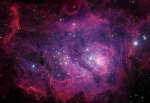 The Wide and Deep Lagoon
9.09.2016
Ridges of glowing interstellar gas and dark dust clouds inhabit the turbulent, cosmic depths of the Lagoon Nebula. Also known as M8, the bright star forming region is about 5,000 light-years distant.
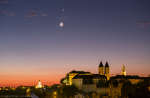 A September Morning Sky
21.09.2017
The Moon, three planets, and a bright star gathered near the ecliptic plane in the September 18 morning sky over Veszprem Castle, Hungary. In this twilight skyscape, Mercury and Mars still shine close to the eastern horizon, soon to disappear in the glare of the Sun.
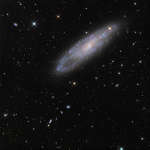 NGC 247 and Friends
16.01.2020
About 70,000 light-years across, NGC 247 is a spiral galaxy smaller than our Milky Way. Measured to be only 11 million light-years distant it is nearby though. Tilted nearly edge-on as seen from our perspective, it dominates this telescopic field of view toward the southern constellation Cetus.
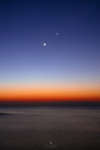 Venus, Mercury, and the Waning Moon
14.11.2020
Yesterday, early morning risers around planet Earth were treated to a waning Moon low in the east as the sky grew bright before dawn. From the Island of Ortigia, Syracuse, Sicily, Italy this simple snapshot found the slender sunlit crescent just before sunrise.
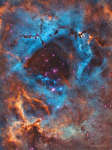 APOD: 2023 February 6 Б In the Heart of the Rosette Nebula
6.02.2023
In the heart of the Rosette Nebula lies a bright cluster of stars that lights up the nebula. The stars of NGC 2244 formed from the surrounding gas only a few million years ago.
 APOD: 2023 December 13 Б Deep Field: The Heart Nebula
13.12.2023
What excites the Heart Nebula? First, the large emission nebula on the left, catalogued as IC 1805, looks somewhat like a human heart. The nebula glows brightly in red light emitted by its most prominent element, hydrogen, but this long-exposure image was also blended with light emitted by silicon (yellow) and oxygen (blue).
 NGC 247 and Friends
5.09.2024
About 70,000 light-years across, NGC 247 is a spiral galaxy smaller than our Milky Way. Measured to be only 11 million light-years distant it is nearby though. Tilted nearly edge-on as seen from our perspective, it dominates this telescopic field of view toward the southern constellation Cetus.
 APOD: 2025 January 1 Б Alpha Centauri: The Closest Star System
1.01.2025
The closest star system to the Sun is the Alpha Centauri system. Of the three stars in the system, the dimmest -- called Proxima Centauri -- is actually the nearest star. The bright stars Alpha Centauri...
 APOD: 2025 November 26 Б Globular Cluster M15 Deep Field
26.11.2025
Stars, like bees, swarm around the center of bright globular cluster M15. The central ball of over 100,000 stars is a relic from the early years of our Galaxy, and continues to orbit the Milky Way's center.
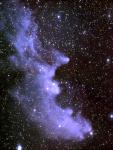 The Witch Head Nebula
27.02.2001
Double, double toil and trouble; Fire burn, and cauldron bubble -- maybe Macbeth should have consulted the Witch Head Nebula. This suggestively shaped reflection nebula is associated with the bright star Rigel in the constellation Orion.
|
January February March April May June July August September October |
|||||||||||||||||||||||||||||||||||||||||||||||||