
|
You entered: constellation
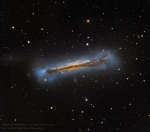 NGC 3682: Sideways Spiral Galaxy
5.09.2018
What do spiral galaxies look like sideways? Featured is a sharp telescopic view of a magnificent edge-on spiral galaxy NGC 3628, a puffy galactic disk divided by dark dust lanes. Of course, this deep galactic portrait puts some astronomers in mind of its popular moniker, The Hamburger Galaxy.
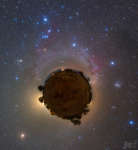 A Little Like Mars
5.03.2021
The surface of this planet looks a little like Mars. It's really planet Earth though. In a digitally stitched little planet projection, the 360 degree mosaic was captured near San Pedro in the Chilean Atacama desert. Telescopes in domes on the horizon are taking advantage of the region's famously dark, clear nights.
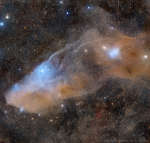 IC 4592: The Blue Horsehead Reflection Nebula
5.07.2021
Do you see the horse's head? What you are seeing is not the famous Horsehead nebula toward Orion but rather a fainter nebula that only takes on a familiar form with deeper imaging. The main part of the here imaged molecular cloud complex is a reflection nebula cataloged as IC 4592.
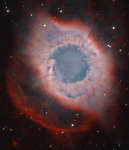 NGC 7293: The Helix Nebula
14.10.2021
A mere seven hundred light years from Earth, toward the constellation Aquarius, a sun-like star is dying. Its last few thousand years have produced the Helix Nebula (NGC 7293), a well studied and nearby example of a Planetary Nebula, typical of this final phase of stellar evolution.
 APOD: 2023 August 13 Б The Sombrero Galaxy in Infrared
13.08.2023
This floating ring is the size of a galaxy. In fact, it is a galaxy -- or at least part of one: the photogenic Sombrero Galaxy, one of the largest galaxies in the nearby Virgo Cluster of Galaxies.
 APOD: 2024 October 9 Б M106: A Spiral Galaxy with a Strange Center
9.10.2024
What's happening at the center of spiral galaxy M106? A swirling disk of stars and gas, M106's appearance is dominated by blue spiral arms and red dust lanes near the nucleus, as shown in the featured image taken from the Kuwaiti desert.
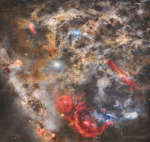 APOD: 2026 March 2 Б The Dusty Surroundings of Orion and the Pleiades
2.03.2026
How well do you know the night sky? OK, but how well can you identify famous sky objects in a very deep image? Either way, here is a test: see if you can find some well-known night-sky icons in a deep image filled with filaments of normally faint dust and gas.
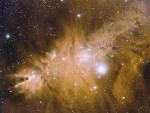 In the Vicinity of the Cone Nebula
12.05.2003
Strange shapes and textures can be found in neighborhood of the Cone Nebula. The unusual shapes originate from fine interstellar dust reacting in complex ways with the energetic light and hot gas being expelled by the young stars.
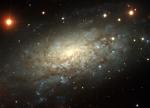 NGC 3621: Far Beyond the Local Group
19.07.2003
Far beyond the local group of galaxies lies NGC 3621, some 22 million light-years away. Found in the serpentine southern constellation Hydra, the loose spiral arms of this gorgeous island universe are loaded with luminous young star clusters and dark dust lanes.
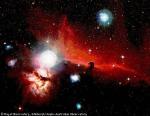 Orion's Horsehead Nebula
25.10.1997
The Horsehead Nebula is one of the most famous nebulae on the sky. It is visible as the black indentation to the red emission nebula seen just to the right of center of the above photograph. The bright star near the center is located in the belt of the familiar constellation of Orion.
|
January February March April May June July August September October |
|||||||||||||||||||||||||||||||||||||||||||||||||