
|
You entered: constellation
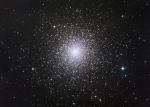 Globular Star Cluster M3
9.06.2007
This immense ball of half a million stars older than the Sun lies over 30,000 light-years away. Cataloged as M3 (and NGC 5272), it is one of about 150 globular star clusters that roam the halo of our Milky Way Galaxy.
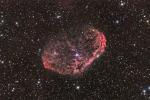 NGC 6888: The Crescent Nebula
11.11.2007
What caused the Crescent Nebula? Looking like an emerging space cocoon, the Crescent Nebula, visible in the center of the above image, was created by the brightest star in its center. A leading progenitor hypothesis has the Crescent Nebula beginning to form about 250,000 years ago.
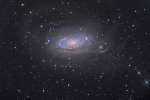 Messier 63: The Sunflower Galaxy
17.04.2008
A bright spiral galaxy of the northern sky, Messier 63 is about 25 million light-years distant in the loyal constellation Canes Venatici. Also cataloged as NGC 5055, the majestic island universe is nearly 100,000 light-years across, about the size of our own Milky Way.
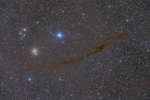 The Dark Doodad Nebula
8.12.2008
What is that strange dark ribbon on the sky? When observing the great globular cluster NGC 4372, observers frequently take note of a strange dark streak nearly three degrees in length running near it. Unnamed, the streak, actually a long molecular cloud, has become known as the Dark Doodad Nebula.
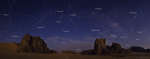 Saharan Starry Night
27.06.2009
This panoramic image of a starry night looks across a dry, desolate landscape. The magnificent view was recorded from Tassili National Park, in the heart of the Sahara desert in southern Algeria. Rising above...
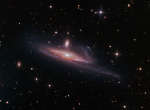 Galaxies in the River
17.07.2010
Large galaxies grow by eating small ones. Even our own galaxy practices galactic cannibalism, absorbing small galaxies that get too close and are captured by the Milky Way's gravity. In fact, the practice...
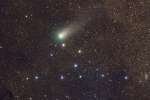 Comet Garradd and the Coat Hanger
9.09.2011
Sweeping through planet Earth's night sky, last weekend Comet Garradd (C/2009 P1) visited this lovely star field along the Milky Way in the constellation Vulpecula. Suggestively oriented, the colorful skyscape features stars in the asterism known as the Coat Hanger with the comet's tail pointing toward the southeast.
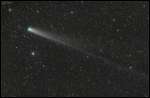 Lovejoy in the New Year
3.01.2014
A rival to vanquished Comet ISON in 2013, Comet Lovejoy (C/2013 R1) still sweeps through early morning skies, captured in this starry scene on New Year's day. The frame stretches some 3.5 degrees across a background of faint stars in the constellation Hercules.
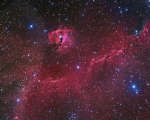 The Seagull Nebula
11.01.2014
A broad expanse of glowing gas and dust presents a bird-like visage to astronomers from planet Earth, suggesting its popular moniker - The Seagull Nebula. This portrait of the cosmic bird covers a 1.6 degree wide swath across the plane of the Milky Way, near the direction of Sirius, alpha star of the constellation Canis Major.
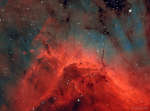 Pillars and Jets in the Pelican Nebula
3.03.2015
What dark structures arise from the Pelican Nebula? Visible as a bird-shaped nebula toward the constellation of a bird (Cygnus, the Swan), the Pelican Nebula is a place dotted with newly formed stars but fouled with dark dust.
|
January February March April May June July August September October |
|||||||||||||||||||||||||||||||||||||||||||||||||