
|
You entered: stars
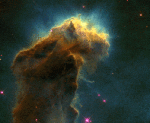 Eagle EGGs in M16
7.11.1995
Star forming regions known as "EGGs" are uncovered at the end of this giant pillar of gas and dust in the Eagle Nebula (M16). EGGs, short for evaporating gaseous globules, are dense regions of mostly molecular hydrogen gas that fragment and gravitationally collapse to form stars.
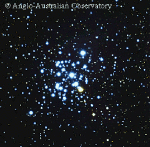 NGC 3293: A Bright Young Open Cluster
29.03.1998
Hot blue stars shine brightly in this beautiful, recently formed galactic or "open" star cluster. Open cluster NGC 3293 is located in the constellation Carina, lies at a distance of about 8000 light years, and has a particularly high abundance of these young bright stars.
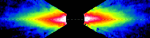 The Dusty Disk of Beta Pic
19.01.1996
This dusty disk, viewed edge on surrounding Beta Pictoris, a star only 50 lightyears distant, may signal the presence of an infant solar system. Beta Pictoris is a young Sun-like star just completing its formative stages.
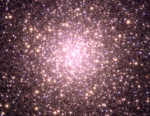 Globular Cluster M3
6.12.1996
This huge ball of stars predates our Sun. Long before mankind evolved, before dinosaurs roamed, and even before our Earth existed, ancient globs of stars condensed and orbited a young Milky Way Galaxy.
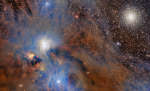 APOD: 2026 July 22 Б The Corona Australis Cloud and the Chandelier Cluster
22.07.2026
The Southern Crown (Corona Australis) dazzles with young and ancient celestial jewels. The Corona Australis Cloud is a collage of reflection and emission nebulae on the left of todayБs image. At 430 light years away, this cloud is one of the closest star-forming regions to Earth.
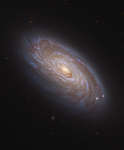 Messier 88
28.12.2022
Charles Messier described the 88th entry in his 18th century catalog of Nebulae and Star Clusters as a spiral nebula without stars. Of course the gorgeous M88 is now understood to be a galaxy full of stars, gas, and dust, not unlike our own Milky Way.
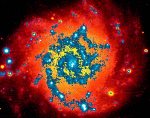 M74: A Grand Design Spiral Galaxy
9.07.1996
M74 is about the same size as our own Milky Way Galaxy. Like our Milky Way, M74 is classified a spiral galaxy. M74's sweeping lanes of stars and dust combined with its small nucleus make it a classic Grand Design Spiral. On the Hubble Sequence of Galaxies, M74 is listed as "Sc".
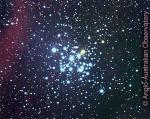 NGC 3293: A Bright Young Open Cluster
9.09.2001
Hot blue stars shine brightly in this beautiful, recently formed galactic or "open" star cluster. Open cluster NGC 3293 is located in the constellation Carina, lies at a distance of about 8000 light years, and has a particularly high abundance of these young bright stars.
 At the Core of M15
20.11.1995
Densely packed stars in the core of the globular cluster M15 are shown in this Hubble Space Telescope (HST) image taken in April of 1994. The stars revealed are contained in an area 1.6 light years across and their colors roughly indicate their temperatures - hot stars appear blue, cooler stars look reddish-orange.
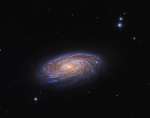 Messier 88
30.01.2010
Charles Messier described the 88th entry in his 18th century catalog of Nebulae and Star Clusters as a spiral nebula without stars. Of course the gorgeous M88 is now understood to be a galaxy full of stars, gas, and dust, not unlike our own Milky Way.
|
January February March April May June July August September October |
|||||||||||||||||||||||||||||||||||||||||||||||||