
|
You entered: stars
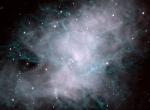 The Crab Nebula in Blue and White
11.07.2000
The Crab Nebula is a complex shell of expanding gas. The Crab Nebula formed from a star that was seen to explode in a supernova about 1000 years ago. This two color composite image taken with the WIYN 3.5-meter telescope shows in great detail filamentary structure of the glowing hydrogen gas.
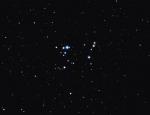 The 37 Cluster
18.11.2005
For the mostly harmless denizens of planet Earth, the brighter stars of open cluster NGC 2169 seem to form a cosmic 37. (Did you expect 42?.) Of course, the improbable numerical asterism appears solely by chance and lies at an estimated distance of 3,600 light-years toward the constellation Orion.
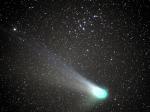 Comet NEAT and the Beehive Cluster
17.06.2004
To the unaided eye, they appeared as similar fuzzy patches. But when a bright comet passed in front of a bright star cluster last month, binoculars and cameras were able to show off their marked differences in dramatic fashion.
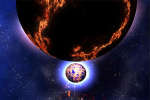 On the Origin of Gold
18.05.2008
Where did the gold in your jewelry originate? No one is completely sure. The relative average abundance in our Solar System appears higher than can be made in the early universe, in stars, and even in typical supernova explosions.
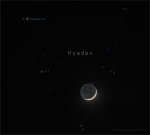 Moon in the Hyades
20.04.2018
Have you seen the Moon lately? On April 18, its waxing sunlit crescent moved through planet Earth's night across a background of stars in the Hyades. Anchored by bright star Aldebaran, the nearby, V-shaped star cluster and complete lunar orb appear in this telephoto image.
 APOD: 2024 April 24 Б Dragons Egg Bipolar Emission Nebula
24.04.2024
How did a star form this beautiful nebula? In the middle of emission nebula NGC 6164 is an unusually massive star. The central star has been compared to an oyster's pearl and an egg protected by the mythical sky dragons of Ara.
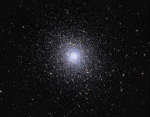 Messier 5
3.08.2012
"Beautiful Nebula discovered between the Balance [Libra] & the Serpent [Serpens] ..." begins the description of the 5th entry in 18th century astronomer Charles Messier's famous catalog of nebulae and star clusters. Though it appeared...
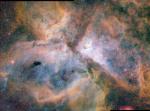 The Carina Nebula in Three Colors
17.07.2001
Stars, like people, do not always go gentle into that good night. The above Carina Nebula, also known as the Keyhole Nebula and NGC 3372, results from dying star Eta Carinae's violently casting off dust and gas during its final centuries.
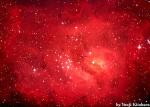 M8: In the Center of the Lagoon Nebula
3.01.2001
In the center of the Lagoon Nebula one finds glowing gas, star clusters, and dense knots of gas and dust just now forming stars. The young open cluster of stars, designated NGC 6523, can be seen in the center of the above image. These stars emit energetic light that ionizes the surrounding hydrogen gas.
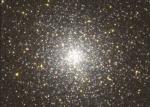 Globular Cluster 47 Tucanae
22.04.2001
Stars come in bunches. Of the over 200 globular star clusters that orbit the center of our Milky Way Galaxy, 47 Tucanae is the second brightest globular cluster (behind Omega Centauri). Known to some affectionately as 47 Tuc or NGC 104, it is only visible from the Southern Hemisphere.
|
January February March April May June July August September October |
|||||||||||||||||||||||||||||||||||||||||||||||||