
|
You entered: time
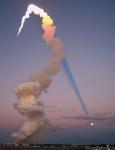 Shuttle Plume Shadow Points to Moon
3.06.2007
Why would the shadow of a space shuttle launch plume point toward the Moon? In early 2001 during a launch of Atlantis, the Sun, Earth, Moon, and rocket were all properly aligned for this photogenic coincidence.
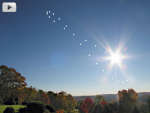 Movie: Analemma Over New Jersey
4.12.2007
An analemma is that figure-8 curve that you get when you mark the position of the Sun at the same time each day throughout planet Earth's year. Above, 26 separate exposures were recorded to illustrate the regular solar motion -- a difficult project performed mostly during the calendar year 2006.
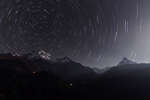 Annapurna Star Trails
28.11.2009
In myth, Atlas holds up the heavens. But in this moonlit mountainscape, peaks of the Himalayan Annapurna Range appear to prop up the sky as seen from Ghandruk, Nepal. From left to right the three main peaks are Annapurna South (7,219 meters), Hiunchuli (6,441 metes), and Machapuchare (6,995 meters).
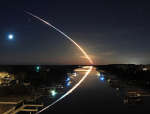 Waterway to Orbit
13.02.2010
The 32nd shuttle mission to the International Space Station, STS-130, left planet Earth on February 8. Its early morning launch to orbit from Kennedy Space Center's pad 39A followed the long, graceful, eastward arc seen in this 2 minute time exposure.
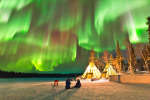 Auroras over Northern Canada
14.07.2014
Gusting solar winds and blasts of charged particles from the Sun resulted in several rewarding nights last December for those anticipating auroras. The above image captured dramatic auroras stretching across a sky near the town of Yellowknife in northern Canada.
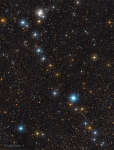 APOD: 2023 January 3 Б Kembles Cascade of Stars
3.01.2023
This line of stars is real. A little too faint to see with the unaided eye, KembleБs Cascade of stars inspires awe when seen with binoculars. Like the Big Dipper though, KembleБs Cascade is an asterism, not a constellation. The asterism is visible in the northern sky toward the long-necked constellation of the Giraffe (Camelopardalis).
 APOD: 2023 April 18 Б Map of Total Solar Eclipse Path in 2024 April
18.04.2023
Would you like to see a total eclipse of the Sun? If so, do any friends or relatives live near the path of next April's eclipse? If yes again, then you might want to arrange a well-timed visit.
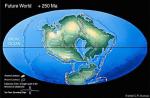 Pangea Ultima: Earth in 250 Million Years
2.10.2000
Is this what will become of the Earth's surface? The surface of the Earth is broken up into several large plates that are slowly shifting. About 250 million years ago, the plates...
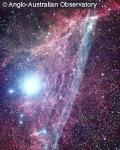 The Vela Supernova Remnant Expands
3.08.1999
The explosion is over but the consequences continue. About eleven thousand years ago a star in the constellation of Vela exploded, creating a strange point of light briefly visible to humans living near the beginning of recorded history.
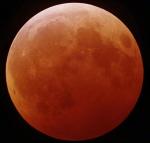 2001: A Total Lunar Eclipse
18.01.2001
The first and only total lunar eclipse for the year 2001 occured on the evening of January 9/10 as the full Moon glided through Earth's shadow. Unlike a total solar eclipse, a total lunar eclipse is visible for anyone on the night side of the planet during the event.
|
January February March April May June July August |
||||||||||||||||||||||||||||||||||||||||||||||||||||||||