
|
You entered: Earth
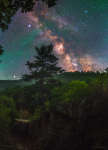 Firefly Milky Way over Russia
6.09.2021
It started with a pine tree. The idea was to photograph a statuesque pine in front of the central band of our Milky Way Galaxy. And the plan, carried out two months ago, was successful -- they both appear prominently. But the resulting 3-frame panorama captured much more.
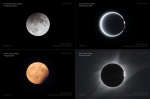 All the Eclipses of 2017
7.12.2017
As seen from planet Earth, all the lunar and solar eclipses of 2017 are represented at the same scale in these four panels. The year's celestial shadow play was followed through four different countries by one adventurous eclipse chaser.
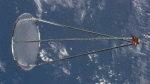 The Shuttle Launches an Inflatable Antenna
25.05.1996
High above the Earth the Space Shuttle Endeavor launches a new type of instrument - an inflatable antenna. The officially designated Inflatable Antenna Experiment was released Monday, May 20th, as part of a Spartan satellite - which contains many scientific experiments. The antenna is roughly the size of a tennis court and is even visible from Earth.
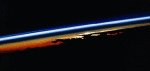 The Sun Also Rises
15.01.2000
Sunrise seen from low Earth orbit can be very dramatic indeed (and the authors don't apologize to Hemingway for using his title!). In this breathtaking view from the space shuttle Endeavor, the Sun is just visible peaking over towering anvil-shaped storm clouds.
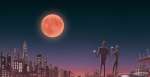 Tonight: A Supermoon Lunar Eclipse
27.09.2015
Tonight a bright full Moon will fade to red. Tonight's moon will be particularly bright because it is reaching its fully lit phase when it is relatively close to the Earth in its elliptical orbit.
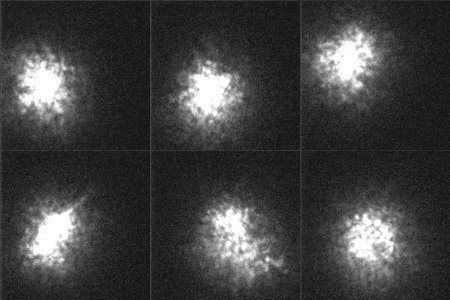 Why Stars Twinkle
25.07.2000
This is what a star really looks like from the surface of the Earth. To the best the human eye can see, stars are so far away they appear the same as would infinitesimal points of light.
 Closest Star has Potentially Habitable Planet
25.08.2016
The star closest to the Sun has a planet similar to the Earth. As announced yesterday, recent observations confirmed that this planet not only exists but inhabits a zone where its surface temperature could allow liquid water, a key ingredient for life on Earth.
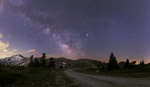 Milky Way and Planets Near Opposition
21.05.2016
In this early May night skyscape, a mountain road near Bursa, Turkey seems to lead toward bright planets Mars and Saturn and the center of our Milky Way Galaxy, a direction nearly opposite the Sun in planet Earth's sky.
 Water From Orion
21.04.1998
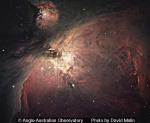
Is Orion all wet? Recent observations have confirmed that water molecules now exist in the famous Orion Nebula, and are still forming. The Orion Nebula (M42, shown above) is known to be composed mostly of hydrogen gas, with all other atoms and molecules being comparatively rare.
 Volcano and Aurora in Iceland
13.06.2004
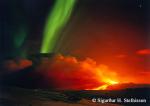
Sometimes both heaven and Earth erupt. In Iceland in 1991, the volcano Hekla erupted at the same time that auroras were visible overhead. Hekla, one of the most famous volcanoes in the world, has erupted at least 20 times over the past millennium, sometimes causing great destruction.
|
January February March April May June July August September October |
|||||||||||||||||||||||||||||||||||||||||||||||||