
|
You entered: Jupiter
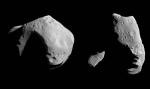 Asteroids
13.03.1998
No asteroid or comet is known to be on a collision course with Earth. The asteroid designated 1997 XF11 had been predicted to come uncomfortably close, but new estimates place its passing beyond the orbit of the Moon. This earth-approaching asteroid was discovered by SpaceWatch astronomer Jim Scotti in December of last year.
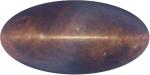 The Far Infrared Sky
17.05.2000
Three major sources contribute to the far-infrared sky: our Solar System, our Galaxy, and our Universe. The above recently released image, in representative colors, is the highest resolution projection yet created of the entire far-infrared sky (60 - 240 microns) created from years of observations by the now-defunct robot spacecraft COBE.
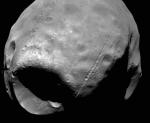 Phobos: Doomed Moon of Mars
6.04.2003
This moon is doomed. Mars, the red planet named for the Roman god of war, has two tiny moons, Phobos and Deimos, whose names are derived from the Greek for Fear and Panic. These...
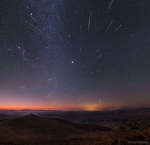 Geminid Meteors over Chile
8.12.2019
Are meteors streaming out from a point in the sky? Yes, in a way. When the Earth crosses a stream of Sun-orbiting meteors, these meteors appear to come from the direction of the stream -- with the directional point called the radiant.
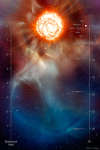 Betelgeuse Imagined
1.01.2020
Why is Betelgeuse fading? No one knows. Betelgeuse, one of the brightest and most recognized stars in the night sky, is only half as bright as it used to be only five months ago.
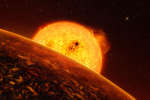 CoRoT Satellite Discovers Rocky Planet
23.09.2009
How similar is exoplanet CoRoT-7b to Earth? The newly discovered extra-solar planet is the closest physical match yet, with a mass about five Earths and a radius of about 1.7 Earths. Also, the home star to CoRoT-7b, although 500 light years distant, is very similar to our Sun.
 Gas and Snow Jets from Comet Hartley 2
23.11.2010
Unusual jets have been discovered emanating from Comet Hartley 2. The EPOXI spacecraft imaged the jets in unprecedented detail during its flyby of the comet earlier this month. Pictured above, sun-illuminated jets shoot away from the two-kilometer long decaying iceberg that orbits the Sun between Earth and Jupiter.
 Encke and the Tadpoles
27.10.2023
History's second known periodic comet is Comet Encke (2P/Encke). As it swings through the inner Solar System, Encke's orbit takes it from an aphelion, its greatest distance from the Sun, inside the orbit of Jupiter to a perihelion just inside the orbit of Mercury.
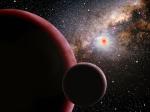 Super Earths May Circle Other Stars
20.03.2006
Are "super-Earths" common around other star systems? Quite possibly. Unexpected evidence for this came to light recently when a planet orbiting a distant star gravitationally magnified the light of an even more distant star.
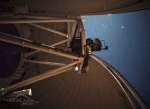 The Light of Stars
8.05.2012
What's moving? Time lapse videos of the sky can be quite spectacular when they last long enough for stars, planets, aurora, and clouds to appear to move in just a few seconds. Pictured...
|
January February March April May June July August September October |
|||||||||||||||||||||||||||||||||||||||||||||||||