
|
You entered: Jupiter
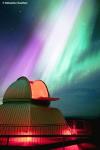 Mount Megantic Magnetic Storm
17.08.2000
Plasma from the Sun and debris from a comet both collided with planet Earth last Saturday morning triggering magnetic storms and a meteor shower in a dazzling atmospheric spectacle. The debris stream from comet...
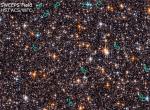 The Hubble SWEEPS Field
13.10.2006
This crowded star field towards the center of our Milky Way Galaxy turns out to be a great place to search for planets beyond our solar system. In fact, repeatedly imaging about...
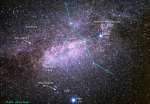 Where is HD 189733
21.03.2008
The star cataloged as HD 189733 is a mere 63 light-years away. Its location is indicated in this deep, wide-angle image of the sky centered on the northern constellation of Cygnus. Considering the many...
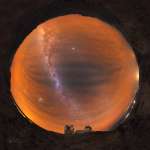 Milky Way vs Airglow Australis
17.05.2018
Captured last week after sunset on a Chilean autumn night, an exceptional airglow floods this allsky view from Las Campanas Observatory. The airglow was so intense it diminished parts of the Milky Way as it arced horizon to horizon above the high Atacama desert.
 APOD: 2024 January 15 Б Star Cluster IC 348 from Webb
15.01.2024
Sometimes, it's the stars that are the hardest to see that are the most interesting. IC 348 is a young star cluster that illuminates surrounding filamentary dust. The stringy and winding dust appears pink in this recently released infrared image from the Webb Space Telescope.
 Galileo Explores Europa
14.08.1996
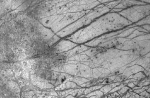
Details of the crazed cracks criss-crossing Europa's frozen surface are apparent in this mosaic of the Galileo spacecraft's latest images of Jupiter's ice-covered moon. Curious white stripes, also seen by Voyager, are clearly visible marking the center of the wide dark fractures.
 The First Image of an Extra Solar Planet
10.05.2005
It's the faint red object, not the bright white one that might be a historic find. The white object is surely a brown dwarf star. Quite possibly, however, the red object is the first direct image of a planet beyond our Solar System.
 Reflected Aurora Over Alaska
12.02.2013
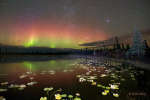
Some auroras can only be seen with a camera. They are called subvisual and are too faint to be seen with the unaided eye. In the above image, the green aurora were easily visible to the eye, but the red aurora only became apparent after a 20-second camera exposure.
 Planets In The Sun
5.05.2000
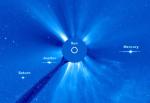
Today, all five naked-eye planets (Mercury, Venus, Mars, Jupiter, Saturn) plus the Moon and the Sun will at least approximately line-up. As viewed from planet Earth, they will be clustered within about 26 degrees, the closest alignment for all these celestial bodies since February 1962, when there was a solar eclipse!
 A Scorpius Sky Spectacular
7.04.2019
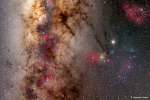
If Scorpius looked this good to the unaided eye, humans might remember it better. Scorpius more typically appears as a few bright stars in a well-known but rarely pointed out zodiacal constellation. To get a spectacular image like this, though, one needs a good camera, color filters, and a digital image processor.
|
January February March April May June July August September October |
|||||||||||||||||||||||||||||||||||||||||||||||||