
|
You entered: Sun
 Mu Cephei
12.10.2023
Mu Cephei is a very large star. An M-class supergiant some 1500 times the size of the Sun, it is one of the largest stars visible to the unaided eye, and even one of the largest in the entire Galaxy.
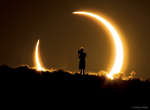 An Annular Solar Eclipse over New Mexico
25.12.2019
What is this person doing? In 2012 an annular eclipse of the Sun was visible over a narrow path that crossed the northern Pacific Ocean and several western US states. In an annular solar...
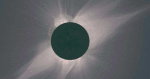 A Total Solar Eclipse
24.10.1995
Pictured above is a total solar eclipse, with the Sun's corona, clearly visible surrounding the Moon. This picture is a composite of differently exposed photos of an eclipse that occurred on July 11, 1991. Today there will be another total eclipse of the Sun, the last until March 1997.
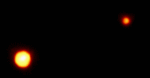 Pluto: The Frozen Planet
28.12.1997
The Hubble Space Telescope imaged Pluto and its moon Charon in 1994. Pluto is usually the most distant planet from the Sun but because of its elliptic orbit Pluto crossed inside of Neptune's orbit in 1979 and will cross back out again in 1999.
 Moon Games
29.11.2025
This is not a screen from a video game. Nestled below the tree-line, the small mountain church does look like it might be hiding from Moon though. In the well-composed telephoto snapshot, taken on November 23, the church walls are partly reflecting light from terrestrial flood lights.
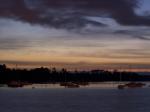 Venus Returns to the Evening Sky
9.06.2005
This serene image of boats moored in the harbor of l'нle-Tudy, Bretagne, France was taken on June 1st, about an hour after sunset. It also features Venus, third brightest celestial object after the Sun and Moon.
 Rainbow at Sunset
7.08.2010
Where is the Sun when you see a rainbow? Behind you, of course. But you can see both a rainbow and the Sun (far right) side by side in this graceful panorama recorded on July 28.
 Find the Moon
11.07.2021
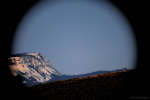
Where's the Moon? Somewhere in this image, the Earth's Moon is hiding. The entire Moon is visible, in its completely full phase, in plain sight. Even the photographer's keen eye couldn...
 APOD: 2025 August 10 Б Zodiacal Road
10.08.2025
What's that strange light down the road? Dust orbiting the Sun. At certain times of the year, a band of sun-reflecting dust from the inner Solar System appears prominently just after sunset -- or just before sunrise -- and is called zodiacal light.
 APOD: 2024 December 22 Б The Local Fluff
22.12.2024
The stars are not alone. In the disk of our Milky Way Galaxy, about 10 percent of visible matter is in the form of gas called the interstellar medium (ISM). The ISM is not uniform and shows patchiness even near our Sun.
|
January February March April May June July August September October |
|||||||||||||||||||||||||||||||||||||||||||||||||