
|
You entered: Sun
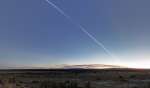 Annular Eclipse After Sunrise
2.03.2017
From northern Patagonia, morning skies were clear and blue on Sunday, February 26. This sweeping composite scene, overlooking Hermoso Valle, Facundo, Chubut, Argentina, follows the Sun after sunrise, capturing an annular solar eclipse. Created...
 Bailys Beads near Solar Eclipse Totality
11.11.2012
Just before the Sun blacks out, something strange occurs. As the Moon moves to completely cover the Sun in a total solar eclipse -- like the one set to occur over parts of Australia on Tuesday -- beads of bright sunlight stream around the edge of the Moon.
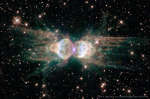 Planetary Nebula Mz3: The Ant Nebula
25.04.2021
Why isn't this ant a big sphere? Planetary nebula Mz3 is being cast off by a star similar to our Sun that is, surely, round. Why then would the gas that is streaming away create an ant-shaped nebula that is distinctly not round?
 Total Solar Eclipse Below the Bottom of the World
5.12.2021
Yesterday there was a total solar eclipse visible only at the end of the Earth. To capture the unusual phenomenon, airplanes took flight below the clouded seascape of Southern Ocean. The featured image shows...
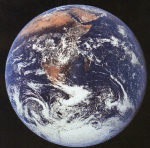 Welcome to Planet Earth
26.10.1997
Welcome to Planet Earth, the third planet from a star named the Sun. The Earth is shaped like a sphere and composed mostly of rock. Over 70 percent of the Earth's surface is water. The planet has a relatively thin atmosphere composed mostly of nitrogen and oxygen.
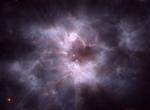 NGC 2440: Cocoon of a New White Dwarf
30.07.2000
Like a butterfly, a white dwarf star begins its life by casting off a cocoon that enclosed its former self. In this analogy, however, the Sun would be a caterpillar and the ejected shell of gas would become the prettiest of all!
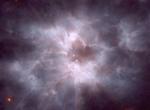 NGC 2440: Cocoon of a New White Dwarf
5.08.2001
Like a butterfly, a white dwarf star begins its life by casting off a cocoon that enclosed its former self. In this analogy, however, the Sun would be a caterpillar and the ejected shell of gas would become the prettiest of all!
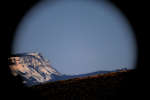 Spot the Moon
2.01.2012
Where's the full Moon? Somewhere in this image, the Earth's Moon is hiding. The entire Moon is visible, in its completely full phase, in plain sight. Even the photographer's keen...
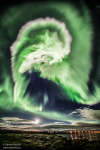 A Spiral Aurora over Iceland
15.09.2015
What's happened to the sky? Aurora! Captured late last month, this aurora was noted by Icelanders for its great brightness and quick development. The aurora resulted from a solar storm, with high energy particles bursting out from the Sun and through a crack in Earth's protective magnetosphere a few days later.
 Detailed View of a Solar Eclipse Corona
13.08.2017
Only in the fleeting darkness of a total solar eclipse is the light of the solar corona easily visible. Normally overwhelmed by the bright solar disk, the expansive corona, the sun's outer atmosphere, is an alluring sight.
|
January February March April May June July August September October |
|||||||||||||||||||||||||||||||||||||||||||||||||