
|
You entered: hydrogen
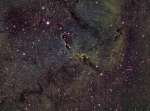 The Elephant s Trunk in IC 1396
26.12.2008
(xxxedit and linkxxx) Like an illustration in a galactic Just So Story, the Elephant's Trunk Nebula winds through the emission nebula and young star cluster complex IC 1396, in the high and far off constellation of Cepheus. Of course, this cosmic elephant's trunk is over 20 light-years long.
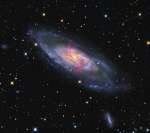 Messier 106
19.03.2011
Close to the Great Bear (Ursa Major) and surrounded by the stars of the Hunting Dogs (Canes Venatici), this celestial wonder was discovered in 1781 by the metric French astronomer Pierre Mechain. Later, it was added to the catalog of his friend and colleague Charles Messier as M106.
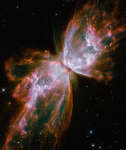 NGC 6903: The Butterfly Nebula
7.06.2013
The bright clusters and nebulae of planet Earth's night sky are often named for flowers or insects. Though its wingspan covers over 3 light-years, NGC 6302 is no exception. With an estimated surface...
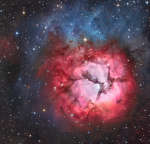 A Beautiful Trifid
12.08.2021
The beautiful Trifid Nebula is a cosmic study in contrasts. Also known as M20, it lies about 5,000 light-years away toward the nebula rich constellation Sagittarius. A star forming region in the plane...
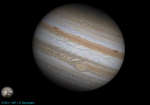 Jupiter Rotates
26.10.2021
Observe the graceful twirl of our Solar System's largest planet. Many interesting features of Jupiter's enigmatic atmosphere, including dark belts and light zones, can be followed in detail. A careful inspection will reveal that different cloud layers rotate at slightly different speeds.
 APOD: 2023 October 3 Б MyCn 18: The Engraved Hourglass Planetary Nebula
3.10.2023
Do you see the hourglass shape -- or does it see you? If you can picture it, the rings of MyCn 18 trace the outline of an hourglass -- although one with an unusual eye in its center. Either way, the sands of time are running out for the central star of this hourglass-shaped planetary nebula.
 Phantoms in Cassiopeia
26.10.2024
These brightly outlined flowing shapes look ghostly on a cosmic scale. A telescopic view toward the constellation Cassiopeia, the colorful skyscape features the swept-back, comet-shaped clouds IC 59 (left) and IC 63. About 600 light-years distant, the clouds aren't actually ghosts.
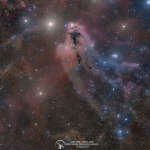 LDN 1622: Dark Nebula in Orion
22.01.2026
The silhouette of an intriguing dark nebula inhabits this cosmic scene. Lynds' Dark Nebula (LDN) 1622 appears against a faint background of glowing hydrogen gas only visible in long telescopic exposures of the region. In contrast, a brighter reflection nebula, vdB 62, is more easily seen just above the dusty dark nebula.
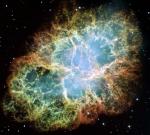 Crab Nebula Mosaic from HST
2.12.2005
The Crab Nebula is cataloged as M1, the first object on Charles Messier's famous list of things which are not comets. In fact, the cosmic Crab is now known to be a supernova remnant, an expanding cloud of debris from the death explosion of a massive star.
 GLIMPSE the Milky Way
16.12.2005
Scroll right and gaze through the dusty plane of our Milky Way Galaxy in infrared light. The cosmic panorama is courtesy of the Galactic Legacy Infrared Mid-Plane Survey Extraordinaire (GLIMPSE) project and the Spitzer Space Telescope.
|
January February March April May June July August September October |
|||||||||||||||||||||||||||||||||||||||||||||||||