
|
You entered: hydrogen
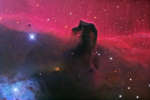 The Horsehead Nebula in Orion
26.11.2008
One of the most identifiable nebulae in the sky, the Horsehead Nebula in Orion, is part of a large, dark, molecular cloud. Also known as Barnard 33, the unusual shape was first discovered on a photographic plate in the late 1800s.
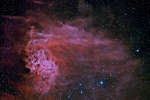 AE Aurigae and the Flaming Star Nebula
26.01.2009
Is star AE Aurigae on fire? No. Even though AE Aurigae is named the flaming star, the surrounding nebula IC 405 is named the Flaming Star Nebula, and the region appears to harbor red smoke, there is no fire.
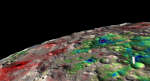 Water Ice Detected Beneath Moons Surface
25.10.2010
Is there enough water on the moon to sustain future astronauts? The question has important implications if humanity hopes to use the Moon as a future outpost. Last year, to help find out, scientists crashed the moon-orbiting LCROSS spacecraft into a permanently shadowed crater near the Moon's South Pole.
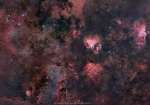 A Sagittarius Starscape
5.09.2014
This rich starscape spans nearly 7 degrees on the sky, toward the Sagittarius spiral arm and the center of our Milky Way galaxy. A telescopic mosaic, it features well-known bright nebulae and star clusters cataloged by 18th century cosmic tourist Charles Messier.
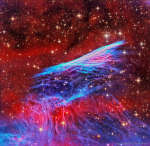 The Pencil Nebula Supernova Shock Wave
14.04.2021
This supernova shock wave plows through interstellar space at over 500,000 kilometers per hour. Near the middle and moving up in this sharply detailed color composite, thin, bright, braided filaments are actually long ripples in a cosmic sheet of glowing gas seen almost edge-on.
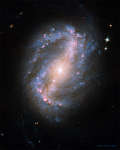 Barred Spiral Galaxy NGC 6217
21.02.2022
Many spiral galaxies have bars across their centers. Even our own Milky Way Galaxy is thought to have a modest central bar. Prominently barred spiral galaxy NGC 6217, featured here, was captured in spectacular detail in this image taken by the Advanced Camera for Surveys on the orbiting Hubble Space Telescope in 2009.
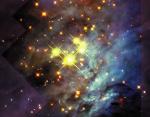 The Brown Dwarfs of Orions Trapezium
30.08.2000
The bright stars above are well known as heart of the Trapezium, an open cluster of stars in the center of the Orion Nebula. The many dim objects, however, are not well known, and have come to attention only on recent images in infrared light.
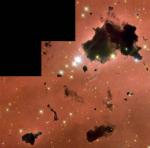 Thackeray's Globules
8.01.2002
Rich star fields and glowing hydrogen gas silhouette dense, opaque clouds of interstellar gas and dust in this Hubble Space Telescope close-up of IC 2944, a bright star forming region in Centaurus, 5,900 light-years away. The largest of these dark globules, first spotted by South African astronomer A. D.
 The Tulip in the Swan
14.11.2014
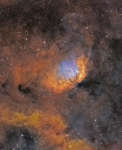
Framing a bright emission region this telescopic view looks out along the plane of our Milky Way Galaxy toward the nebula rich constellation Cygnus the Swan. Popularly called the Tulip Nebula the glowing cloud of interstellar gas and dust is also found in the 1959 catalog by astronomer Stewart Sharpless as Sh2-101.
 A Beautiful Trifid
20.10.2017
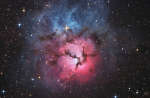
The beautiful Trifid Nebula is a cosmic study in contrasts. Also known as M20, it lies about 5,000 light-years away toward the nebula rich constellation Sagittarius. A star forming region in the plane...
|
January February March April May June July August September October |
|||||||||||||||||||||||||||||||||||||||||||||||||