
|
You entered: hydrogen
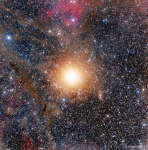 Behind Betelgeuse
11.05.2020
What's behind Betelgeuse? One of the brighter and more unusual stars in the sky, the red supergiant star Betelgeuse can be found in the direction of famous constellation Orion. Betelgeuse, however, is actually...
 APOD: 2025 July 9 Б A Beautiful Trifid
9.07.2025
The beautiful Trifid Nebula is a cosmic study in contrasts. Also known as M20, it lies about 5,000 light-years away toward the nebula rich constellation Sagittarius. A star forming region in the plane...
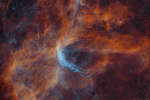 APOD: 2026 May 22 Б The Nebulous Realm of WR 134
22.05.2026
This cosmic snapshot covers a field of view over twice as wide as the full Moon within the boundaries of the high-flying constellation Cygnus. Made using astronomical narrowband filters, the image highlights the bright edge of a ring-like nebula traced by the glow of ionized hydrogen and oxygen gas.
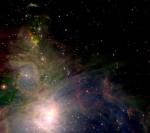 UKIRT: Aloha Orion
6.01.2005
At the edge of a dense molecular cloud, filaments of gas, cosmic dust, and a multitude of young stars beckon in this penetrating image of the Orion Nebula. Alluring structures in the well-known star...
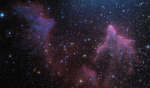 IC 59 and IC 63 in Cassiopeia
3.11.2011
These bright rims and flowing shapes suggest to some melting ice cream on a cosmic scale. Looking toward the constellation Cassiopeia, the colorful (zoomable) skyscape features the swept back, comet-shaped clouds IC 59 (left) and IC 63.
 Simeis 147: Supernova Remnant
18.05.2017
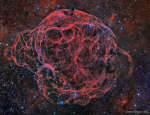
It's easy to get lost following intricate filaments in this detailed image of faint supernova remnant Simeis 147. Also cataloged as Sharpless 2-240 it goes by the popular nickname, the Spaghetti Nebula. Seen toward the boundary of the constellations Taurus and Auriga, it covers nearly 3 degrees or 6 full moons on the sky.
 NGC 300: A Cosmic Gemstone with Stars and Gas Clouds
16.07.2026
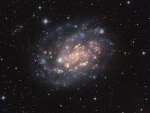
This sparkling, colorful gemstone is a spiral galaxy, NGC 300. It is one of the closest spiral galaxies to Earth, only about 6 million light-years away. But does it really look like this? Here is a more standard portrait of it.
 Solar Shock Wave
30.04.1999
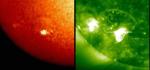
On September 24, 1997 a shock wave blasted across the surface of the sun at speeds of 250 to 600 kilometers per second. On planet Earth, observer Barry Reynolds photographed the expanding shock front (left) in the light emitted by hydrogen atoms at the solar surface.
 Star Forming Region NGC 3582
28.04.2008
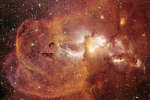
What's happening in the NGC 3582 nebula? Bright stars and interesting molecules are forming. The complex nebula resides in the star forming region called RCW 57. Visible in this image are dense knots...
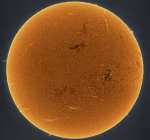 Orange Sun Scintillating
15.11.2011
Our Sun is becoming a busy place. Taken just last week, the Sun was captured sporting numerous interesting features including one of the larger sunspot groups yet recorded: AR 1339 visible on the image right. Only last year, the Sun was emerging from an unusually quiet Solar Minimum that lasted for years.
|
January February March April May June July August September October |
|||||||||||||||||||||||||||||||||||||||||||||||||