
|
You entered: Earth
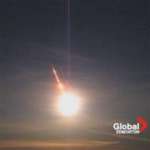 Fireball Over Edmonton
25.11.2008
What if you're driving down the street and an object from space shoots across the sky right in front of you? Such was the case last week for many people in south central Canada.
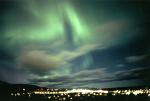 A Yukon Aurora
8.10.2001
Last week was another good week for auroras. The story began about two weeks ago when two large Coronal Mass Ejections exploded off the Sun. Waves of elementary particles and ions swept out past the Earth on September 28 and 29, causing many auroras.
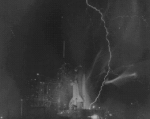 Lightning and the Space Shuttle
10.11.1995
There are many things about lightning that are not understood. Lightning has been seen in the atmospheres of Venus, Earth, Jupiter, and Saturn. A leading theory is that collisions of particles in clouds cause large areas of positive and negative charge.
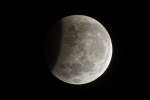 August Lunar Eclipse
9.08.2017
August's Full Moon is framed in this sharp, high dynamic range composition. Captured before sunrise on August 8 from Sydney, Australia, south is up and the Earth's dark, umbral shadow is at the left, near the maximum phase of a partial lunar eclipse.
 Fireworks vs Supermoon
6.07.2023
On July 4, an almost Full Moon rose in planet Earth's evening skies. Also known as a Buck Moon, the full lunar phase (full on July 3 at 11:39 UTC) was near perigee, the closest point in the Moon's almost monthly orbit around planet Earth.
 Red Moon, Green Beam
18.04.2014
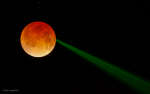
This is not a scene from a sci-fi special effects movie. The green beam of light and red lunar disk are real enough, captured in the early morning hours of April 15. Of course, the reddened lunar disk is easy to explain as the image was taken during this week's total lunar eclipse.
 Rotating Asteroid Bennu from OSIRIS REx
13.11.2018
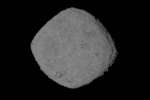
Could this close-by asteroid ever hit the Earth? Eventually yes -- but probably not for a very long time, even though the asteroid is expected to pass inside the orbit of the Moon next century.
 Magna Bubbles from Mt Etna
16.04.2003
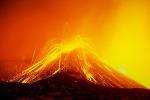
Mt. Etna erupted spectacularly in 2001 June. Pictured above, the volcano was photographed expelling bubbles of hot magma, some of which measured over one meter across. One reason planetary geologists study Earth's Mt. Etna is because of its likely similarity to volcanoes on Mars. Mt.
 Mars Climate Orbiter Launches
24.12.1998
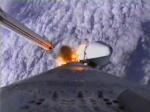
Looking down from atop a Delta II rocket blasting skyward, solid fuel boosters fall away (left) and the Earth's limb slides into view. These pictures from the launch of the Mars Climate Orbiter were taken as it climbed away from Cape Canaveral Air Station Space Launch Complex 17 on December 11.
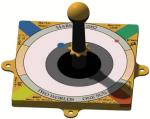 A Sundial for Mars
28.04.1999
When Mars Surveyor arrives at Mars in 2002, it will carry a sundial. Even though batteries and a solar array will power the Mars Surveyor Lander, the sundial has been included to allow a prominent public display of time.
|
January February March April May June July August September October |
|||||||||||||||||||||||||||||||||||||||||||||||||