
|
You entered: Earth
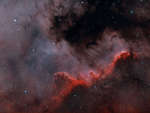 The Cygnus Wall of Star Formation
22.01.2013
The North America nebula on the sky can do what the North America continent on Earth cannot -- form stars. Specifically, in analogy to the Earth-confined continent, the bright part that appears as Central America and Mexico is actually a hot bed of gas, dust, and newly formed stars known as the Cygnus Wall.
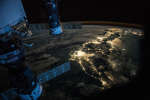 Cities at Night
5.03.2016
Looking toward the south from an altitude of 400 kilometers, this stunning snapshot from orbit finds bright lights of Tokyo and cities across central and southern Japan, planet Earth shining upward through broken clouds. The spacefaring perspective was captured last July by astronaut Scott Kelly during his stay on board the International Space Station.
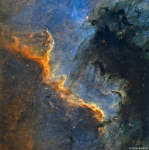 The Cygnus Wall of Star Formation
15.08.2022
The North America nebula on the sky can do what the North America continent on Earth cannot -- form stars. Specifically, in analogy to the Earth-confined continent, the bright part that appears as Central America and Mexico is actually a hot bed of gas, dust, and newly formed stars known as the Cygnus Wall.
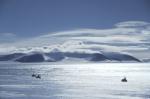 Searching for Meteorites in Antarctica
26.12.2002
Where is the best place on Earth to find meteorites? Although meteors fall all over the world, they usually just sink to the bottom of an ocean, are buried by shifting terrain, or are easily confused with terrestrial rocks.
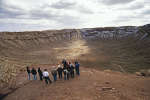 Inside Barringer Meteor Crater
11.08.2009
What happens when a meteor hits the ground? Usually nothing much, as most meteors are small, and indentations they make are soon eroded away. About 50,000 years ago, however, a large meteor created Barringer Meteor Crater in Arizona, USA. Also known simply as Meteor Crater, the resulting impact basin spans over a kilometer.
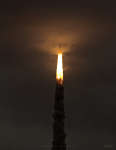 Chandrayaan 2 Launch
27.07.2019
On July 22nd this GSLV (Geosynchronous Satellite Launch Vehicle) MkIII rocket vanished from sight into a cloud bank an instant after this dramatic snapshot was taken. Launched from India's Satish Dhawan Space Centre it carried the Chandrayaan 2 mission spacecraft into Earth orbit.
 Valles Marineris: The Grand Canyon of Mars
29.05.2016
Mars will look good in Earth's skies over the next few days -- but not this good. To get a view this amazing, a spacecraft had to actually visit the red planet. Running across the image center, though, is one the largest canyons in the Solar System.
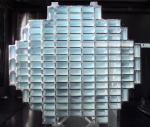 Aerogel For Stardust
18.02.1999
On February 7th, this honey comb of aluminum cells filled with aerogel was launched on the STARDUST mission to interplanetary space. STARDUST's goal is to capture dust from a comet's tail and return to planet Earth - the first sample return mission to a comet!
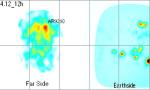 Far Side of the Sun
3.05.2001
You may think it's impossible to see through the Sun, but maps of the Sun's far side are now made routinely by instruments on board the sun-staring SOHO spacecraft. This is one such map from April 12.
 Supermoon over Spanish Castle
19.12.2016
No, this castle was not built with the Moon attached. To create the spectacular juxtaposition, careful planning and a bit of good weather was needed. Pictured, the last supermoon of 2016 was captured last week rising directly beyond one of the towers of Bellver Castle in Palma de Mallorca on the Balearic Islands of Spain.
|
January February March April May June July August September October |
|||||||||||||||||||||||||||||||||||||||||||||||||