
|
You entered: light
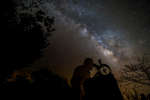 Along the Milky Way
3.07.2021
You can't walk along the Milky Way. Still, under a dark sky you can explore it. To the eye the pale luminous trail of light arcing through the sky on a dark, moonless night does appear to be a path through the heavens.
 NGC 2392: Double Shelled Planetary Nebula
16.02.2020
To some, this huge nebula resembles a person's head surrounded by a parka hood. In 1787, astronomer William Herschel discovered this unusual planetary nebula: NGC 2392. More recently, the Hubble Space Telescope imaged the nebula in visible light, while the nebula was also imaged in X-rays by the Chandra X-ray Observatory.
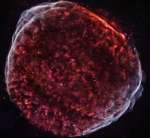 X rays from Supernova Remnant SN 1006
23.04.2013
What looks like a puff-ball is surely the remains of the brightest supernova in recorded human history. In 1006 AD, it was recorded as lighting up the nighttime skies above areas now known as China, Egypt, Iraq, Italy, Japan, and Switzerland.
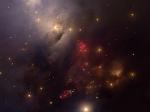 In the Center of Reflection Nebula NGC 1333
21.05.2007
The dust is so thick in the center of NGC 1333 that you can hardly see the stars forming. Conversely, the very dust clouds that hide the stars also reflects their optical light, giving NGC 1333's predominantly blue glow the general designation of a reflection nebula.
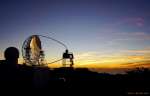 Cherenkov Telescope at Sunset
18.10.2018
On October 10, a new telescope reflected the light of the setting Sun. With dark horizon above and sunset colors below, its segmented mirror inverts an image of the beautiful evening sky in this snapshot from the Roque del Los Muchachos Observatory on the Canary Island of La Palma.
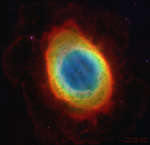 M57: The Ring Nebula from Hubble
17.08.2021
Except for the rings of Saturn, the Ring Nebula (M57) is probably the most famous celestial circle. Its classic appearance is understood to be due to our own perspective, though. The recent mapping...
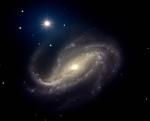 NGC 613: Spiral of Dust and Stars
1.10.2005
When morning twilight came to the Paranal Observatory in Chile, astronomers Mark Neeser and Peter Barthel interrupted their search for faint quasars, billions of light-years away. And just for a moment, they used Very Large Telescopes at the European Southern Observatory to appreciate the beauty of the nearby Universe.
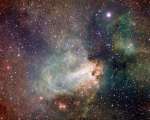 Star Factory Messier 17
30.06.2011
Sculpted by stellar winds and radiation, the star factory known as Messier 17 lies some 5,500 light-years away in the nebula-rich constellation Sagittarius. At that distance, this degree wide field of view spans almost 100 light-years, courtesy of ESO's new VLT Survey Telescope and OmegaCAM.
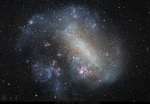 The Large Cloud of Magellan
27.08.2015
The 16th century Portuguese navigator Ferdinand Magellan and his crew had plenty of time to study the southern sky during the first circumnavigation of planet Earth. As a result, two fuzzy cloud-like objects easily...
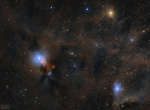 Stardust in the Perseus Molecular cloud
14.01.2017
Clouds of stardust drift through this deep skyscape. The cosmic scene spans nearly 2 degrees across the Perseus molecular cloud some 850 light-years away. A triangle of dusty nebulae reflecting light from embedded stars is captured in the telescopic field of view.
|
January February March April May June July August September October |
|||||||||||||||||||||||||||||||||||||||||||||||||