
|
You entered: light
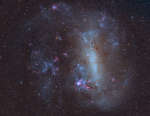 The Large Cloud of Magellan
5.09.2019
The 16th century Portuguese navigator Ferdinand Magellan and his crew had plenty of time to study the southern sky during the first circumnavigation of planet Earth. As a result, two fuzzy cloud-like objects easily...
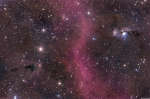 Decorating the Sky
12.12.2019
Bright stars, clouds of dust and glowing nebulae decorate this cosmic scene, a skyscape just north of Orion's belt. Close to the plane of our Milky Way galaxy, the wide field view spans about 5.5 degrees. Striking bluish M78, a reflection nebula, is on the right.
 APOD: 2023 December 26 Б IC 443: The Jellyfish Nebula
26.12.2023
Why is this jellyfish swimming in a sea of stars? Drifting near bright star Eta Geminorum, seen at the right, the Jellyfish Nebula extends its tentacles from the bright arcing ridge of emission left of center.
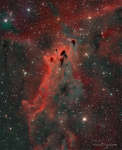 APOD: 2026 April 28 Б CG 30: Cometary Globules
28.04.2026
They're like mountain peaks, but they are forming stars. Bright-rimmed, flowing shapes gather near the center of this rich starfield toward the borders of the nautical southern constellations Puppis and Vela. Composed of interstellar gas and dust, the grouping of light-year sized cometary globules is about 1300 light-years distant.
 APOD: 2024 May 24 Б M78 from the Euclid Space Telescope
24.05.2024
Star formation can be messy. To help find out just how messy, ESA's new Sun-orbiting Euclid telescope recently captured the most detailed image ever of the bright star forming region M78. Near...
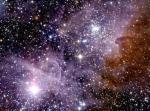 The Keyhole Nebula in Infrared
13.06.2000
About three million years ago, the stars in the Keyhole Nebula began to form. The above picture of the Keyhole Nebula, also known as the Carina Nebula or NGC 3372, shows in infrared light many facets of this dramatic stellar nursery which lies only 9,000 light-years away.
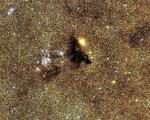 Open Cluster NGC 6520 from CFHT
22.07.2002
Did you ever have a day when it felt like a dark cloud was following you around? For the open cluster of stars NGC 6520, every day is like this. On the left of the above picture are many of NGC 6520's bright blue stars.
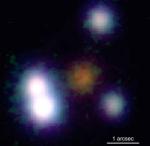 PG 1115+080: A Gravitational Cloverleaf
31.03.1999
All four blue images in the above photograph are the same object. The gravitational lens effect of the red, foreground, elliptical galaxy visible near image center creates a cloverleaf image of the single distant quasar. Light from the quasar is pulled around the massive galaxy in different paths, corresponding to different images.
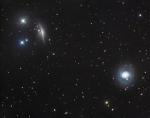 NGC 1055 and M77
15.12.2006
Large spiral galaxy NGC 1055 (top left) joins spiral M77 in this lovely cosmic view toward the constellation Cetus. The narrowed, dusty appearance of edge-on spiral NGC 1055 contrasts nicely with the face-on view of M77's bright nucleus and spiral arms.
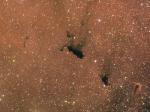 Molecular Cloud Barnard 163
21.03.2007
It may look to some like a duck, but it lays stars instead of eggs. In the center of the above image lies Barnard 163, a nebula of molecular gas and dust so thick that visible light can't shine through it.
|
January February March April May June July August September October |
|||||||||||||||||||||||||||||||||||||||||||||||||