
|
You entered: Galactic Center
 COMPTEL Explores The Radioactive Sky
24.07.1996
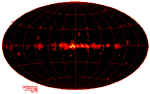
Diffuse gas clouds laced with radioactive aluminum atoms (Al26) line the plane of our Milky Way Galaxy! How do we see them? Relying on the Compton Effect, the COMPTEL instrument onboard NASA's immense orbiting Compton Gamma Ray Observatory can "see" the 1.8 million electron Volt gamma rays emitted by the radioactive decay.
 Unusual Flashes Toward Globular Cluster M22
3.07.2001
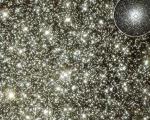
What is causing the unusual flashes behind globular cluster M22? This teaming ball of stars is the brightest globular cluster visible in Earth's northern hemisphere. M22, shown in full in the inset, spans about 50 light years away and lies 8500 light-years toward the constellation of Sagittarius.
 M16: Nebula With Star Cluster
18.01.1997
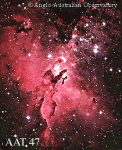
The photogenic M16 shown above is composed of a young star cluster associated with a spectacular emission nebulae lined with clouds of interstellar dust. The gorgeous spectacle lies toward the galactic center region, some 7,000 light years distant in the constellation Serpens.
 Counting Stars in the Infrared Sky
19.07.2002
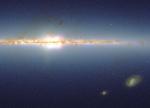
The bulging center of our Milky Way Galaxy, dark cosmic clouds, the thin galactic plane, and even nearby galaxies are easy to spot in this sky view. But each pixel in the digital image is actually based on star counts alone -- as derived from the Two Micron All Sky Survey (2MASS) database.
 Millions of Stars in Omega Centauri
16.04.2002
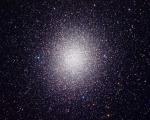
Pictured above is the largest ball of stars in our Galaxy. About 10 million stars orbit the center of this globular cluster - named Omega Centauri - as this giant globular cluster orbits our Galactic center.
 Mangaia's Milky Way
24.09.2011
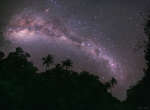
From Sagittarius to Carina, the Milky Way Galaxy shines in this dark night sky above planet Earth's lush island paradise of Mangaia. Familiar to denizens of the southern hemisphere, the gorgeous skyscape includes the bulging galactic center at the upper left and bright stars Alpha and Beta Centauri just right of center.
 Constellations and Cloudy Skies
11.07.2007
Recorded earlier in July, the clouds of planet Earth reflect moonlight and a faint, reddish glow in this serene sea and skyscape. Beyond them lie the cosmic dust and star clouds of the Milky Way.
 A Graceful Arc
25.12.2009
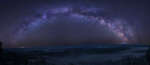
The graceful arc of the Milky Way begins and ends at two mountain peaks in this solemn night sky panorama. Created from a 24 frame mosaic, exposures tracking Earth and sky were made separately...
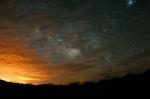 Star Clouds over Arizona
24.04.2006
The clouds in the foreground are much different than the clouds in the background. In the foreground are a photogenic deck of Earth-based water clouds. The long exposure used to create the above photograph makes the light from the left, reflected from Phoenix, Arizona, USA, appear like a sunset.
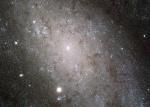 The Stars of NGC 300
16.04.2004
Like grains of sand on a cosmic beach, individual stars of large spiral galaxy NGC 300 are resolved in this sharp image from the Hubble Space Telescope's Advanced Camera for Surveys (ACS).
|
January February March April May June July August September October |
|||||||||||||||||||||||||||||||||||||||||||||||||