
|
You entered: NASA
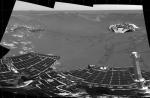 Opportunity Rover Indicates Ancient Mars Was Wet
3.03.2004
Was Mars ever wet enough to support life? To help answer this question, NASA launched two rover missions to the red planet and landed them in regions that satellite images indicated might have been covered with water.
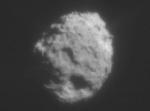 Comet Wild 2s Nucleus from Stardust
3.01.2004
What does a comet nucleus look like? Yesterday the robot spacecraft Stardust answered this question by returning the most detailed images yet of the center of a comet. The icy centers of comets are usually hidden from Earth-bound telescopes by opaque dust and gas that boils off during approach to the Sun.
 Mercury Astronauts and a Redstone
6.04.1997
Space suited project Mercury astronauts John H. Glenn, Virgil I. Grissom, and Alan B. Shepard Jr. (left to right) are pictured here posing in front of a Redstone rocket in this vintage 1961 NASA publicity photo. Project Mercury was the first U.S. program designed to put humans in space.
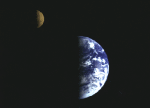 The Earth-Moon System
29.06.1995
A double planet? From 4 million miles away on December 16, 1992, NASA's robot spacecraft Galileo took this picture of the Earth-moon system. The bright, sunlit half of the Earth contrasts strongly with the darker subdued colors of the moon. Our moon is one of the largest moons in the solar system.
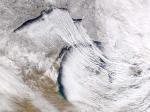 Lake Effect Snow on Earth
30.11.2004
What are those strange clouds stretching out from these lakes? The clouds are caused by cold air moving over a warm water and result in bands of lake-effect snow. The rising bands of moistened, warmed air that drop lake-effect snow alternate with clear bands of falling cold air.
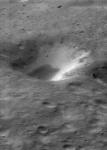 A Two Toned Crater on Asteroid Eros
22.01.2001
What lies beneath the surface of asteroid Eros? This image taken two weeks ago by the robot NEAR spacecraft orbiting the dark asteroid shows a kilometer-wide crater where some type of light material lies beneath some of the darker surface regolith.
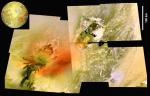 Io Volcano Culann Patera
18.12.2002
What causes the unusual colors surrounding Io's volcanoes? Io, the innermost large moon of Jupiter, is known to be the most tumultuous body in the Solar System. Approximately the size of Earth...
 The Face on Mars
22.07.1995
This image, showing what looks to be a human face sculpted on the martian surface, was produced using data from NASA's Viking 1 orbiter in 1976. Described in a press release...
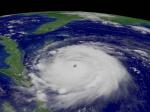 Hurricane Frances Approaches Florida
3.09.2004
A major hurricane is heading for Florida. Hurricane Frances, one of the stronger storm systems of modern times, may cross the eastern coast of Florida sometime tomorrow. Those in the path of a hurricane should take precautions. For example, NASA's Kennedy Space Center has completely shut down.
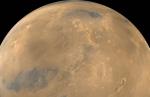 Five to Mars
2.05.2003
Come December 2003 - January 2004, an armada of five new invaders from Earth should arrive on the shores of the Red Planet -- the Japanese ( ISAS) Nozomi orbiter, the European Space Agency's Mars Express orbiter carrying the Beagle 2 lander, and NASA's own two Mars Exploration Rovers.
|
January February March April May June July August September October |
|||||||||||||||||||||||||||||||||||||||||||||||||