
|
You entered: Observatory
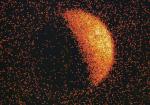 X-Ray Moon
4.10.2003
This x-ray image of the Moon was made by the orbiting ROSAT (Röntgensatellit) Observatory in 1990. In this digital picture, pixel brightness corresponds to x-ray intensity. Consider the image in three parts: the bright hemisphere of the x-ray moon, the darker half of the moon, and the x-ray sky background.
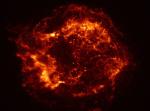 Chandras First Light: Cassiopeia A
27.08.1999
Cosmic wreckage from the detonation of a massive star is the subject of this official first image from NASA's Chandra X-ray Observatory. The supernova remnant, known as Cassiopeia A, was produced when a star exploded around 300 years ago in this northern sky constellation.
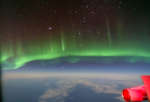 SOFIA s Southern Lights
29.07.2022
SOFIA, the Stratospheric Observatory for Infrared Astronomy, is a Boeing 747SP aircraft modified to carry a large reflecting telescope into the stratosphere. The ability of the airborne facility to climb above about 99 percent of Earth's infrared-blocking atmosphere has allowed researchers to observe from almost anywhere over the planet.
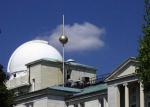 The USNO Millennium Time Ball
29.10.1999
In the nineteenth century, dropping a time ball from a prominent location was a practical way of communicating the time to the surrounding country side and ships at sea. Initiating a fledgling time service for the United States, the U.S. Naval Observatory dropped a time ball at precisely noon every day begining in 1845.
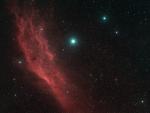 NGC 1499: California Nebula
10.03.2005
Drifting through the Orion Arm of the spiral Milky Way Galaxy, this cosmic cloud by chance echoes the outline of California on the west coast of the United States. Our own Sun also lies within the Milky Way's Orion Arm, only about 1,500 light-years from the California Nebula.
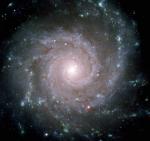 M74: The Perfect Spiral
24.05.2003
If not perfect, then this spiral galaxy is at least one of the most photogenic. An island universe of about 100 billion stars, 30 million light-years away toward the constellation Pisces, NGC 628 or M74 presents a gorgeous face-on view to earthbound astronomers.
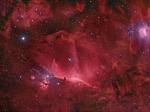 Wisps Surrounding the Horsehead Nebula
21.02.2006
The famous Horsehead Nebula in Orion is not alone. A deep exposure shows that the dark familiar shaped indentation, visible just below center, is part of a vast complex of absorbing dust and glowing gas.
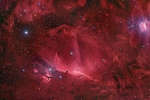 Wisps Surrounding the Horsehead Nebula
6.04.2008
The famous Horsehead Nebula in Orion is not alone. A deep exposure shows that the dark familiar shaped indentation, visible just below center, is part of a vast complex of absorbing dust and glowing gas.
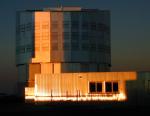 Yepun
Yepun
27.09.2000
Pictured above on September 3rd, the enclosure for the 8.2 meter telescope christened Yepun glints dramatically in the light of the setting sun. Later that evening, under dark skies at Paranal Observatory, Chile, astronomers...
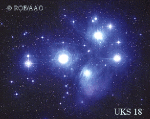 The Pleiades Star Cluster
3.09.1996
It is the most famous star cluster on the sky. The Pleiades can be seen without binoculars from even the depths of a light-polluted city. Also known as the Seven Sisters and M45, the Pleiades is one of the brightest and most easily visible open clusters on the sky.
|
January February March April May June July August September October |
|||||||||||||||||||||||||||||||||||||||||||||||||