
|
You entered: dark
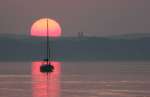 Equinox Sunset
24.09.2009
Often inspiring, or offering a moment for contemplation, a sunset is probably the most commonly photographed celestial event. But this uncommonly beautiful sunset picture was taken on a special day, the Equinox on September 22.
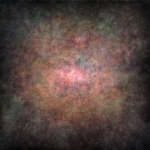 Median Mashup: Hubble s Top 100
13.09.2014
Now, as you sip your cosmic latte you can view 100 Hubble Space Telescope images at the same time. The popular scenes of the cosmos as captured from low Earth orbit are all combined into this single digital presentation. To make it, Hubble's top 100 images were downloaded and resized to identical pixel dimensions.
 Iridescent by Moonlight
4.12.2021
In this snapshot from November 18, the Full Moon was not far from Earth's shadow. In skies over Sicily the brightest lunar phase was eclipsed by passing clouds though. The full moonlight was dimmed and momentarily diffracted by small but similar sized water droplets near the edges of the high thin clouds.
 APOD: 2024 August 5 Б Milky Way Over Tunisia
5.08.2024
That's no moon. On the ground, that's the Lars Homestead in Tunisia. And that's not just any galaxy. That's the central band of our own Milky Way galaxy. Last, that's not just any meteor. It is a bright fireball likely from last year's Perseids meteor shower.
 A Slice Through an Artificial Universe
23.06.1998
We live in the era of humanity when most of our Universe is being mapped. To help understand these maps, astronomers computationally estimate the appearance of several possible candidate universes, to which maps of the real Universe can be compared.
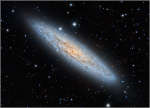 NGC 253: The Sculptor Galaxy
20.12.2011
NGC 253 is not only one of the brightest spiral galaxies visible, it is also one of the dustiest. Discovered in 1783 by Caroline Herschel in the constellation of Sculptor, NGC 253 lies only about ten million light-years distant.
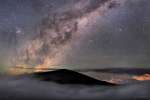 Over the Top
19.06.2014
The central bulge of our Milky Way Galaxy rises above a sea of clouds in this ethereal scene. An echo of the Milky Way's dark dust lanes, the volcanic peak in foreground silhouette is on France's Réunion Island in the southern Indian Ocean.
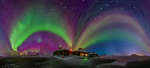 Lapland Northern Lights
8.04.2016
Early spring in the northern hemisphere is good season for aurora hunters. Near an equinox Earth's magnetic field is oriented to favor interactions with the solar wind that trigger the alluring glow of the northern lights. On March 28/29 the skies over Kaunispää Hill, Lapland, Finland did not disappoint.
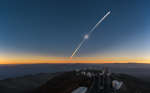 La Silla Eclipse Sequence
5.07.2019
The road to the high mountaintop La Silla Observatory in the Chilean Atacama Desert also led in to the path of July 2nd's total solar eclipse. Recorded at regular intervals before and after...
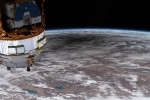 Eclipse under the ISS
27.06.2020
The dark shadow of the New Moon reached out and touched planet Earth on June 21. A high definition camera outside the International Space Station captured its passing in this snapshot from low Earth orbit near the border of Kazakhstan and China.
|
January February March April May June July August September |
|||||||||||||||||||||||||||||||||||||||||||||||||