
|
You entered: dark
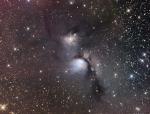 M78: Stardust and Starlight
4.11.2005
Interstellar dust clouds and bright nebulae abound in the fertile constellation of Orion. One of the brightest, M78, is just below center in this sharp widefield view, covering an area north of Orion's belt. At a distance of about 1,500 light-years, the bluish nebula itself is about 5 light-years across.
 Twilight in a Flower
6.05.2023
Transformed into the petals of a flower, 16 exposures show the passage of day into night in this creative timelapse skyscape. Start at the top and move counterclockwise to follow consecutive moments as the twilight sky turns an ever darker blue and night blossoms.
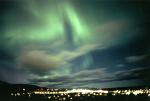 A Yukon Aurora
8.10.2001
Last week was another good week for auroras. The story began about two weeks ago when two large Coronal Mass Ejections exploded off the Sun. Waves of elementary particles and ions swept out past the Earth on September 28 and 29, causing many auroras.
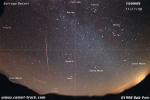 An Annotated Leonid
11.11.2001
The 1998 Leonids Meteor Shower was one of the most photographed meteor event in history. Patient observers saw bright meteors streak across dark skies every few minutes, frequently leaving fading trails stretching across the sky. High above the Anza-Borrego Desert, a meteor was photographed streaking up from the radiant constellation of the Leonids: Leo.
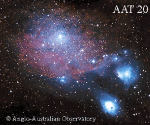 Nebulosity in Sagittarius
10.08.1997
What causes the colors in this beautiful nebulosity in Sagittarius? Dubbed NGC 6589 and NGC 6590, the colors of this nebulosity, are caused by gas and dust. The blue color of the nebula nearest the bright stars is caused by reflection off interstellar dust.
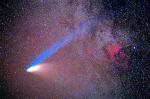 Hale Bopp and the North American Nebula
9.10.1997
Comet Hale-Bopp's recent encounter with the inner Solar System allowed many breath-taking pictures. Above, Comet Hale-Bopp was photographed on March 8th in the constellation of Cygnus. Visible on the right in red is the North American Nebula, a bright emission nebula observable from a dark location with binoculars.
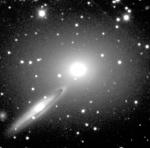 Seeing Through Galaxies
5.12.1997
In this dramatic picture, spiral galaxy NGC 5091 appears in the foreground. Tilted nearly edge-on, the dust lanes between its spiral arms are clearly visible. The large elliptical galaxy NGC 5090 lies just beyond it - both are about 100 million light years distant in the southern constellation Centaurus. Can you see through the spiral galaxy?
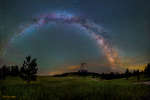 Milky Way over Devils Tower
30.10.2014
A mysterious formation known as Devils Tower rises into the dark above northeastern Wyoming's prairie landscape in this 16 frame panoramic view. Seen against the night sky's thin, pale clouds and eerie...
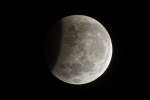 August Lunar Eclipse
9.08.2017
August's Full Moon is framed in this sharp, high dynamic range composition. Captured before sunrise on August 8 from Sydney, Australia, south is up and the Earth's dark, umbral shadow is at the left, near the maximum phase of a partial lunar eclipse.
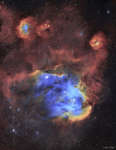 IC 2944: The Running Chicken Nebula
20.04.2020
To some, it looks like a giant chicken running across the sky. To others, it looks like a gaseous nebula where star formation takes place. Cataloged as IC 2944, the Running Chicken Nebula spans about 100 light years and lies about 6,000 light years away toward the constellation of the Centaur (Centaurus).
|
January February March April May June July August September |
|||||||||||||||||||||||||||||||||||||||||||||||||