
|
You entered: camera
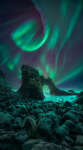 APOD: 2023 January 11 Б Spiral Aurora over Iceland
11.01.2023
The scene may look like a fantasy, but it's really Iceland. The rock arch is named Gatklettur and located on the island's northwest coast. Some of the larger rocks in the foreground span a meter across. The fog over the rocks is really moving waves averaged over long exposures.
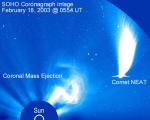 Comet NEAT Passes an Erupting Sun
24.02.2003
As Comet NEAT flared last week, the Sun roared. Just as the comet swooped inside the orbit of Mercury and developed a long and flowing tail of gas and dust, the Sun emitted a huge Coronal Mass Ejection (CME).
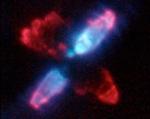 Shells in the Egg Nebula
20.05.1997
The Egg Nebula is taking a beating. Like a baby chick pecking its way out of an egg, the star in the center of the Egg Nebula is casting away shells of gas and dust as it slowly transforms itself into a white dwarf star.
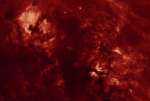 Cygnus Without Stars
24.04.2008
The sky is full of hydrogen, though it can take a sensitive camera and telescope to see it. For example, this twelve-degree-wide view of the northern part of the constellation Cygnus reveals cosmic clouds of hydrogen gas along the plane of our Milky Way galaxy.
 A Darkened Sky
20.09.2008
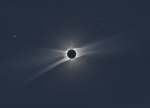
For a moment on August 1st, the daytime sky grew dark along the path of a total solar eclipse. While watching the geocentric celestial event from Mongolia, photographer Miloslav Druckmuller recorded multiple images with two separate cameras as the Moon blocked the bright solar disk and darkened the sky.
 Kepler s Streak
9.03.2009
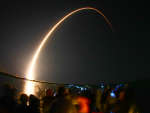
Streaking skyward, a Delta II rocket carries NASA's Kepler spacecraft aloft into the clear night of March 6. The dramatic scene was recorded in a time exposure from the crowded pier in Jetty Park at the northern end of Cocoa Beach, Florida, about 3 miles from the Cape Canaveral launch site.
 Horsehead and Orion Nebulae
10.03.2009
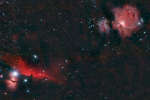
Adrift 1,500 light-years away in one of the night sky's most recognizable constellations, the glowing Orion Nebula and the dark Horsehead Nebula are contrasting cosmic vistas. They appear in opposite corners of this stunning mosaic taken with a digital camera attached to a small telescope.
 M83: The Thousand Ruby Galaxy
8.10.2015
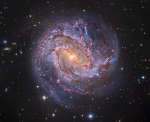
Big, bright, and beautiful, spiral galaxy M83 lies a mere twelve million light-years away, near the southeastern tip of the very long constellation Hydra. Prominent spiral arms traced by dark dust lanes and blue star clusters lend this galaxy its popular name, The Southern Pinwheel.
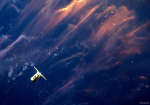 Approach above Sunset
2.05.2017
There it is! The Cygnus supply ship was a welcome sight to the astronauts on the International Space Station just over a week ago. Launched three days before on a United Launch Alliance Atlas...
 Andromeda in a Single Shot
25.06.2021
How far can you see? The Andromeda Galaxy, 2.5 million light years away, is the most distant object easily seen by the unaided eye. Other denizens of the night sky, like stars, clusters, and nebulae, are typically hundreds to thousands of light-years distant.
|
January February March April May June July August |
||||||||||||||||||||||||||||||||||||||||||||||||||||||||