
|
You entered: camera
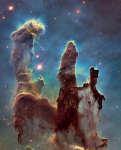 Hubble 25th Anniversary: Pillars of Creation
6.01.2015
To celebrate 25 years (1990-2015) of exploring the Universe from low Earth orbit, the Hubble Space Telescope's cameras were used to revisit its most iconic image. The result is this sharper, wider view of the region dubbed the Pillars of Creation, first imaged by Hubble in 1995.
 ISS Double Transit
11.09.2015
Not once, but twice the International Space Station transits the Sun on consecutive orbits of planet Earth in this video frame composite. The scene was captured on August 22 from a single well-chosen location in Schmalenbeck, Germany where the ISS created intersecting shadow paths only around 7 kilometers wide.
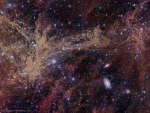 The M81 Galaxy Group through the Integrated Flux Nebula
26.06.2017
Distant galaxies and nearby nebulas highlight this deep image of the M81 Group of galaxies. First and foremost in this 80-exposure mosaic is the grand design spiral galaxy M81, the largest galaxy in the image, visible on the lower right.
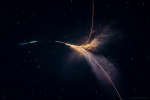 Falcon 9 Boostback
11.03.2020
Short star trails appear in this single 84 second long exposure, taken on March 6 from a rotating planet. The remarkable scene also captures the flight of a Falcon 9 rocket and Dragon cargo spacecraft over Cape Canaveral Air Force Station shortly after launch, on a resupply mission bound for the International Space Station.
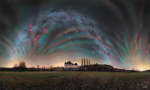 APOD: 2023 February 15 Б Airglow Sky over France
14.02.2023
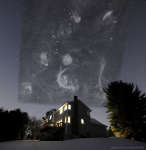
This unusual sky was both familiar and unfamiliar. The photographer's mission was to capture the arch of the familiar central band of our Milky Way Galaxy over a picturesque medieval manor. The surprise was that on this January evening, the foreground sky was found glowing in a beautiful but unfamiliar manner.
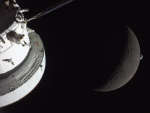 APOD: 2026 April 11 Б Artemis II: Flight Day 6
10.04.2026
On flight day 6 (April 6) the Artemis II mission achieved a historic lunar flyby. Rounding the lunar far side, the deep space maneuver marked humanity's first venture to the Moon since Apollo 17 in 1972.
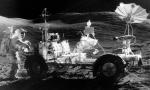 Apollo 17 s Lunar Rover
9.06.2001
In December of 1972, Apollo 17 astronauts Eugene Cernan and Harrison Schmitt spent about 75 hours exploring the Moon's Taurus-Littrow valley while colleague Ronald Evans orbited overhead. Cernan and Schmitt were the last humans to walk or ride on the Moon - aided in their explorations by a Lunar Roving Vehicle.
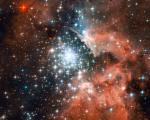 Starburst Cluster in NGC 3603
5.10.2007
A mere 20,000 light-years from the Sun lies NGC 3603, a resident of the nearby Carina spiral arm of our Milky Way Galaxy. NGC 3603 is well known to astronomers as one of the Milky Way's largest star-forming regions.
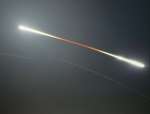 Moon Slide Slim
19.02.2008
No special filters - or even a telescope - are required to enjoy a leisurely lunar eclipse. In fact, watched from all over the night side of planet Earth, these regular celestial performances have entertained many casual skygazers. Still, this eye-catching picture of a lunar eclipse may look unfamiliar.
 The Big Picture
11.04.2009
Intricate, glowing nebulae that shine in planet Earth's night sky are beautiful to look at in deep images made with telescopes and sensitive cameras. But they are faint and otherwise invisible to the naked-eye. That makes their relative location and extent on the sky difficult to appreciate.
|
January February March April May June July August |
||||||||||||||||||||||||||||||||||||||||||||||||||||||||