
|
You entered: emission
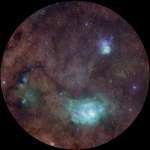 Pan STARRS and Nebulae
12.10.2012
A single image from the world's most powerful survey instrument captured this spectacular skyview. Looking toward Sagittarius, the scene spans nearly 3 degrees or six times the width of the Full Moon.
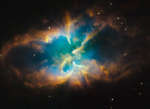 Planetary Nebula NGC 2818 from Hubble
13.07.2014
NGC 2818 is a beautiful planetary nebula, the gaseous shroud of a dying sun-like star. It could well offer a glimpse of the future that awaits our own Sun after spending another 5 billion years or so steadily using up hydrogen at its core, and then finally helium, as fuel for nuclear fusion.
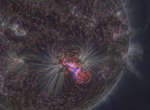 Solar Flare from a Sharper Sun
21.11.2014
Solar active region AR2192 was the largest recorded sunspot group of the last 24 years. Before rotating off the Earth-facing side of the Sun at the end of October, it produced a whopping six energetic X-class flares.
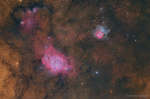 A Sagittarius Triplet
10.08.2015
These three bright nebulae are often featured in telescopic tours of the constellation Sagittarius and the crowded starfields of the central Milky Way. In fact, 18th century cosmic tourist Charles Messier cataloged two of them; M8, the large nebula left of center, and colorful M20 on the right.
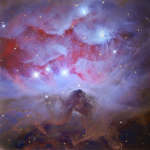 Reflections on the 1970s
13.01.2016
The 1970s are sometimes ignored by astronomers, like this beautiful grouping of reflection nebulae in Orion - NGC 1977, NGC 1975, and NGC 1973 - usually overlooked in favor of the substantial glow from the nearby stellar nursery better known as the Orion Nebula.
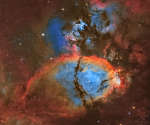 IC 1795: The Fishhead Nebula
31.07.2019
To some, this nebula looks like the head of a fish. However, this colorful cosmic portrait really features glowing gas and obscuring dust clouds in IC 1795, a star forming region in the northern constellation Cassiopeia.
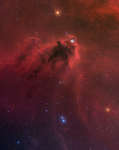 LDN 1622: Dark Nebula in Orion
21.02.2020
The silhouette of an intriguing dark nebula inhabits this cosmic scene. Lynds' Dark Nebula (LDN) 1622 appears against a faint background of glowing hydrogen gas only visible in long telescopic exposures of the region. In contrast, the brighter reflection nebula vdB 62 is more easily seen, just above and right of center.
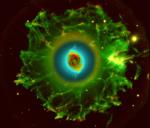 Halo of the Cat's Eye
4.09.2002
The Cat's Eye Nebula (NGC 6543) is one of the best known planetary nebulae in the sky. Its haunting symmetries are seen in the very central region of this stunning false-color picture, processed...
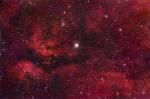 Central Cygnus
4.01.2007
Supergiant star Gamma Cygni lies at the center of the Northern Cross, famous asterism in the constellation Cygnus the Swan. Known by the proper name Sadr, the bright star also lies at the center...
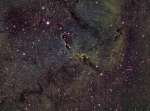 The Elephant s Trunk in IC 1396
26.12.2008
(xxxedit and linkxxx) Like an illustration in a galactic Just So Story, the Elephant's Trunk Nebula winds through the emission nebula and young star cluster complex IC 1396, in the high and far off constellation of Cepheus. Of course, this cosmic elephant's trunk is over 20 light-years long.
|
January February March April May June July August September |
|||||||||||||||||||||||||||||||||||||||||||||||||