
|
You entered: Moon
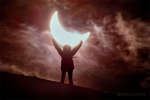 APOD: 2025 March 30 Б A Partial Solar Eclipse over Iceland
30.03.2025
What if the Sun and Moon rose together? That happened yesterday over some northern parts of planet Earth as a partial solar eclipse occurred shortly after sunrise. Regions that experienced the Moon blocking part of the Sun included northeastern parts of North America and northwestern parts of Europe, Asia, and Africa.
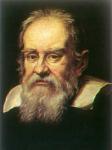 Galileo Demonstrates the Telescope
14.10.2001
Galileo Galilei made a good discovery great. Upon hearing at age 40 that a Dutch optician had invented a glass that made distant objects appear larger, Galileo crafted his own telescope and turned it toward the sky.
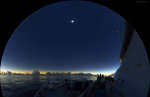 6 Minutes 42 Seconds
30.07.2009
The July 22nd total solar eclipse was the longest of the 21st century. From the point of maximum eclipse along the Moon's shadow track across the Pacific Ocean, the Moon completely blocked the Sun for a total of 6 minutes and 39 seconds.
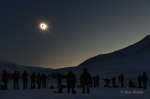 Northern Equinox Eclipse
20.03.2015
Snowy and cold is weather you might expect at the start of spring for Longyearbyen on the Arctic archipelago of Svalbard, Norway. But that turned out to be good weather for watching the Moon's umbral shadow race across northern planet Earth.
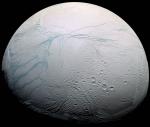 Fresh Tiger Strips on Saturns Enceladus
6.09.2005
The tiger stripes on Saturn's moon Enceladus might be active. Even today, they may be spewing ice from the moon's icy interior into space, creating a cloud of fine ice particles over the moon's South Pole and creating Saturn's mysterious E-ring.
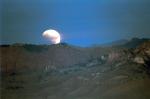 Eclipse Over The Mountain
2.09.1999
Undaunted by world wide anticipation of the August 11 total solar eclipse, the moon also performed a lunar eclipse just two weeks earlier, on July 28. Crossing the edge of Earth's shadow the moon was only partially eclipsed - but the spectacle could be seen by observers located across the Earth's night side.
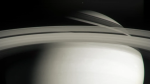 Views from Cassini at Saturn
13.06.2011
What has the Cassini orbiter seen since arriving at Saturn? The above music video shows some of the highlights. In the first time-lapse sequence (00:07), a vertical line appears that is really Saturn's thin rings seen nearly edge-on. Soon some of Saturn's moon shoot past.
 An Apollo 15 Panorama
13.01.2004
The Apollo 15 mission to Earth's Moon was dedicated to better understanding the surface of the moon by exploring mountains, valleys, maria, and highlands. Astronauts David Scott and James Irwin spent nearly three days on the Moon while Alfred Worden orbited above in the Command Module.
 APOD: 2025 April 6 Б Moonquakes Surprisingly Common
6.04.2025
Why are there so many moonquakes? Analyses of seismometers left on the moon during the Apollo moon landings reveal a surprising number of moonquakes occurring within 100 kilometers of the surface. In fact, 62 moonquakes were detected in data recorded between 1972 and 1977.
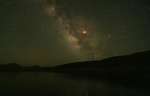 A Total Lunar Eclipse Over Tajikistan
7.11.2022
If the full Moon suddenly faded, what would you see? The answer was recorded in a dramatic time lapse video taken during the total lunar eclipse in 2011 from Tajikistan. During a total lunar eclipse, the Earth moves between the Moon and the Sun, causing the moon to fade dramatically.
|
January February March April May June July August September October |
|||||||||||||||||||||||||||||||||||||||||||||||||