
|
You entered: Moon
 Astronaut Exploring: An Apollo 15 Panorama
11.11.2018
What would it be like to explore the Moon? NASA's Apollo missions gave humans just this chance in the late 1960s and early 1970s. In particular, the Apollo 15 mission was dedicated to better understanding the surface of the Moon by exploring mountains, valleys, maria, and highlands.
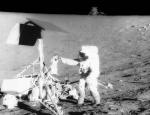 Apollo 12 Visits Surveyor 3
5.10.2003
Apollo 12 was the second mission to land humans on the Moon. The landing site was picked to be near the location of Surveyor 3, a robot spacecraft that had landed on the Moon three years earlier.
 An Apollo 15 Panorama: Astronaut Exploring
30.11.2008
What would it be like to explore the Moon? NASA's Apollo missions gave humans just this chance in the late 1960s and early 1970s. In particular, the Apollo 15 mission was dedicated to better understanding the surface of the Moon by exploring mountains, valleys, maria, and highlands.
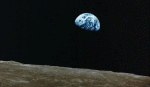 Earth Rise
25.12.1995
During the 1968 Christmas season Frank Borman, James Lovell, and William Anders flew the Apollo 8 command module From the Earth to the Moon and back (launched Dec. 21, achieved 10 lunar orbits, landed Dec. 27).
 Eclipse Over New York
4.11.2013
A sunrise over New York City rarely looks like this. Yesterday, however, the Sun rose partly eclipsed by the Moon as seen from much of the eastern North American and northern South America. Simultaneously, much of Africa, already well into daytime, saw the eclipse from beginning to end.
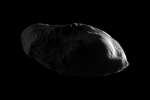 Prometheus Remastered
5.04.2010
What does Saturn's shepherd moon Prometheus really look like? The raw images from the robotic Cassini spacecraft's January flyby of the small moon showed tantalizing clues on grainy images, but now that the Cassini team has digitally remastered these images, many more details have come out.
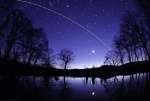 Discovery in Twilight
10.03.2011
As evening twilight faded on March 7, sky gazers around planet Earth enjoyed a beautiful pairing of young crescent Moon and brilliant planet Jupiter. Along with stars setting in the west, the two bright...
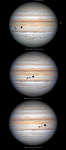 Triple Transit and Mutual Events
21.08.2021
These three panels feature the Solar System's ruling gas giant Jupiter on August 15 as seen from Cebu City, Phillipines, planet Earth. On that date the well-timed telescopic views detail some remarkable performances, transits and mutual events, by Jupiter's Galilean moons.
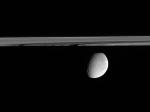 Slightly Beneath Saturns Ring Plane
5.04.2006
When orbiting Saturn, be sure to watch for breathtaking superpositions of moons, rings, and shadows. One such picturesque vista was visible recently to the robot Cassini spacecraft now orbiting Saturn. In late February, Cassini captured a Rhea, the second largest moon of Saturn, while looking up from slightly beneath Saturn's expansive ring plane.
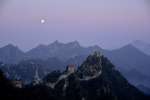 The Great Wall by Moonlight
12.03.2015
Last Friday, an almost Full Moon rose as the Sun set, over this mountainous landscape north of Beijing, China. Also near apogee, the farthest point in its elliptical orbit around planet Earth, it was this year's smallest and faintest Full Moon.
|
January February March April May June July August September October |
|||||||||||||||||||||||||||||||||||||||||||||||||