
|
You entered: stars
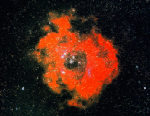 NGC 2237: The Rosette Nebula
14.02.1996
Would the Rosette nebula by any other name look as sweet? The bland New General Catalog designation of NGC 2237 doesn't appear to diminish the appearance of the this flowery emission nebula. Inside the nebula lies an open cluster of bright young stars designated NGC 2244.
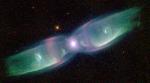 M2-9: Wings of a Planetary Nebula
23.12.1997
Are stars better appreciated for their art after they die? Actually, stars usually create their most artistic displays as they die. In the case of low-mass stars like our Sun and M2-9 pictured above, the stars transform themselves from normal stars to white dwarfs by casting off their outer gaseous envelopes.
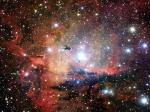 NGC 281: Cluster, Clouds, and Globules
7.04.2003
NGC 281 is a busy workshop of star formation. Prominent features include a small open cluster of stars, a diffuse red-glowing emission nebula, large lanes of obscuring gas and dust, and dense knots of dust and gas in which stars may still be forming.
 APOD: 2023 May 1 Б Carina Nebula North
1.05.2023
The Great Carina Nebula is home to strange stars and iconic nebulas. Named for its home constellation, the huge star-forming region is larger and brighter than the Great Orion Nebula but less well known because it is so far south -- and because so much of humanity lives so far north.
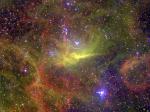 Nebulas Surrounding Wolf Rayet Binary
BAT99 49
Nebulas Surrounding Wolf Rayet Binary
BAT99 49
21.04.2004
How could two young stars power these colorful interstellar gas clouds? Although hidden by thick dust, the stars spew forceful ions and energetic radiation that cause the clouds to fragment and light up.
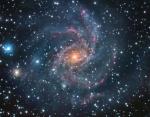 Facing NGC 6946
4.10.2002
From our vantage point in the Milky Way Galaxy, we see NGC 6946 face on. The big beautiful spiral galaxy is located just 10 million light-years away, behind a veil of foreground stars in the high and far-off constellation of Cepheus.
 The Big Dipper
24.06.2011
The best known asterism in northern skies, The Big Dipper is easy to recognize, though some might see The Plough. Either way, the star names and the familiar outlines will appear in this thoughtfully composed 24 frame mosaic when you slide your cursor over the image.
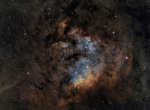 NGC 7822 in Cepheus
23.05.2015
Hot, young stars and cosmic pillars of gas and dust seem to crowd into NGC 7822. At the edge of a giant molecular cloud toward the northern constellation Cepheus, the glowing star forming region lies about 3,000 light-years away. Within the nebula, bright edges and dark shapes are highlighted in this colorful skyscape.
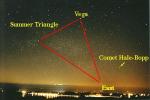 Vega
Vega
23.08.1998
Vega is a bright blue star 25 light years away. Vega is the brightest star in the Summer Triangle, a group of stars easily visible summer evenings in the northern hemisphere. The name Vega...
 NGC 6822: Barnard s Galaxy
2.12.2021
Grand spiral galaxies often seem to get all the glory, flaunting their young, bright, blue star clusters in beautiful, symmetric spiral arms. But small galaxies form stars too, like nearby NGC 6822, also known as Barnard's Galaxy.
|
January February March April May June July August September October |
|||||||||||||||||||||||||||||||||||||||||||||||||